
Your three highest-leverage moves are a fully optimised Google Business Profile (GBP), an HTML menu with structured data, and an active review capture system. Get those three working together and you have the foundation that drives most of your new covers from search. A fully optimised GBP listing receives roughly five times more direction requests than a basic one, and for many restaurants it drives more guest actions than the website itself. Expect GBP updates to show effect within days; broader local SEO rankings typically move in a few months. DIY costs are mostly your time, while a specialist agency in Australia typically charges a monthly subscription. Start this week with GBP, then layer in the rest.
- GBP first. It is the single fastest way to appear in Google Maps and the Local Pack, where most dining decisions are made.
- HTML menu with schema. A PDF menu is invisible to Google. An HTML menu with Restaurant and MenuItem schema makes your dishes, prices and dietary tags searchable.
- Review capture system. Review recency outweighs total count; a restaurant with 50 recent reviews can outrank one with 200 older ones.
Table of Contents
- What does a prioritised local SEO plan look like for restaurants?
- How do you claim and optimise your Google Business Profile to win the map pack?
- What on-site changes help restaurants rank and convert in local search?
- How do you generate more five-star reviews and manage your reputation?
- How do citations and local links help your restaurant rank?
- What local content and social proof actually drives bookings?
- How do you measure whether your local SEO is actually working?
- Can you do local SEO yourself, and what does it cost in Australia?
- A 90-day plan: week-by-week priorities and on-the-ground tactics
- Key takeaways
- The part most restaurant owners get backwards
- How Bridge PR helps restaurants get found and fill tables
- Useful sources
- FAQ
What does a prioritised local SEO plan look like for restaurants?
Restaurant marketing operates across eleven distinct online touchpoints, and owned channels (your website, GBP, reviews) compound over time in a way paid channels never do. The sequence below reflects that logic: front-load the assets you own, then scale.
-
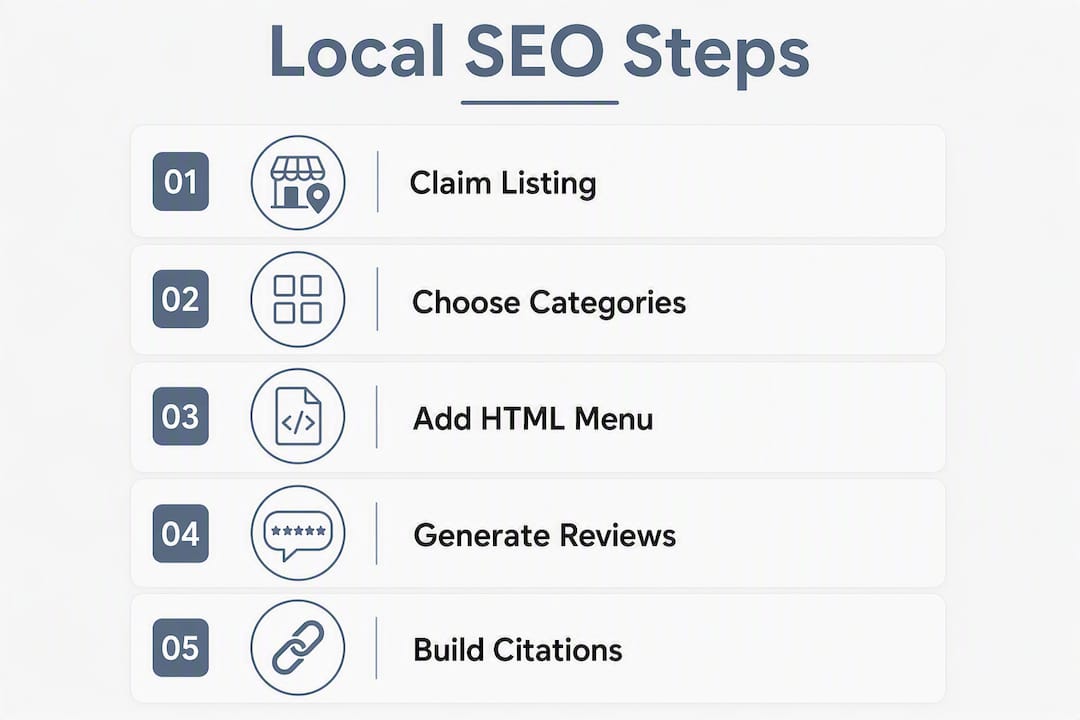
Claim and verify your GBP (Quick win — days). Owner task. Go to Google Business Profile, claim your listing, and complete the verification postcard or video process. Nothing else matters until this is done.
-
Complete every GBP field (Quick win — 1–2 days). Owner or manager. Add accurate hours, holiday hours, cuisine categories, business description, booking link, menu link, and at least 10 photos. Incomplete profiles lose to complete ones.
-
Convert your PDF menu to HTML (Quick win — 1–3 days). Web developer or a capable manager. Build individual menu pages (or at minimum one well-structured menu page) with item names, descriptions, prices and dietary tags in plain HTML.
-
Add schema markup (Medium — 1 week). Web developer. Implement Restaurant/LocalBusiness, Menu, MenuItem, openingHours and AggregateRating schema. This makes your site eligible for rich results.
-
Audit and fix NAP consistency (Medium — 1–2 weeks). Owner or manager. Check your Name, Address and Phone number across 70–80 directories, not just the obvious five or six. Minor differences like "St" vs "Street" confuse Google's matching algorithms.
-
Set up a review capture system (Medium — 1 week). Owner or manager. Deploy QR codes at tables, a post-visit SMS or email trigger, and a staff script. Aim for a steady stream of new Google reviews every week.
-
Build local content (Long — ongoing). Owner, manager, or content partner. Publish neighbourhood landing pages, event pages and dish spotlights targeting local search terms. This is where a content partner like Bridge PR earns its keep.
-
Earn local citations and links (Long — ongoing). Owner or external. Get listed on TripAdvisor, Zomato, Menulog, Uber Eats, and local council event pages. Pursue mentions from local food writers and community partners.
-
Measure, report, adjust (Ongoing — monthly). Owner or agency. Track direction requests, phone calls, booking taps and review velocity in GBP Insights, Google Search Console and GA4.
Sequencing note: Resist the urge to run Facebook or Google Ads before steps 1–4 are solid. Paid traffic sent to a slow site with a PDF menu and no reviews wastes budget. Owned channels compound; paid channels stop the moment funding stops.
Pro Tip: Before you touch anything else, open Google Maps and search your own restaurant name. Screenshot what a new customer sees. That screenshot is your baseline — every improvement you make should move that image forward.
How do you claim and optimise your Google Business Profile to win the map pack?
GBP is where most dining decisions happen. When someone searches "Thai restaurant Fortitude Valley" or "coffee near me," the three listings that appear in the Local Pack are almost always the ones with the most complete, active profiles.

Claiming and verifying your listing
Go to business.google.com, search for your restaurant, and claim the existing listing or create a new one. Google will ask you to verify via postcard, phone, or a short video showing the exterior and interior. Video verification has become the most common method. Do not skip this step or hand it to someone without giving them your Google account credentials.
Choosing the right categories
Your primary category is the single most important ranking signal in GBP. Pick the most specific option available: "Japanese Restaurant" beats "Restaurant," and "Sushi Restaurant" beats "Japanese Restaurant" if that is your core offer. Add secondary categories for any distinct offerings (e.g., "Ramen Restaurant," "Izakaya Restaurant"). Avoid stuffing categories that do not reflect your actual menu.
Fields that move the needle
- Business description: 750 characters. Lead with your cuisine type, neighbourhood, and one or two signature dishes. Write it the way a diner would search, not the way a PR person would pitch.
- Hours: Set accurate regular hours and update holiday hours before every public holiday. Incorrect hours are one of the most common reasons for one-star reviews.
- Menu: Add your menu directly in GBP using the built-in menu editor, and link to your HTML menu page. Both matter.
- Photos: Upload at least 10 photos at launch, then add two to three per week. Cover food, interior, exterior, and staff. Restaurants that post photos consistently see higher engagement in GBP.
- Booking and order buttons: Connect your reservation system (e.g., ResDiary, Quandoo, or a direct booking page) and your delivery partners (Menulog, Uber Eats, Deliverect if you use an aggregator). GBP supports both native booking integrations and custom URLs.
Daily and weekly maintenance
Respond to every review within 24–48 hours. Post a GBP update (a new dish, an event, a limited offer) at least once a week. These signals tell Google the listing is active, which correlates with higher Local Pack placement.
Pro Tip: If you use a third-party reservation system, point your GBP booking button to your own booking page rather than the platform's generic search page. Add UTM parameters (e.g., ?utm_source=google&utm_medium=gbp&utm_campaign=booking) so GA4 can attribute reservations back to GBP. You keep the data; the platform keeps the booking.
What on-site changes help restaurants rank and convert in local search?
Your website is the second pillar. GBP drives the click; your site closes the booking. Most restaurant sites fail on two counts: a PDF menu and a slow mobile experience.
Why an HTML menu matters
A PDF is a single file Google cannot read item by item. An HTML menu lets Google index individual dish names, descriptions, dietary tags, and prices. When someone searches "gluten-free pasta Newtown" or "vegan brunch Brisbane," a well-structured HTML menu page can appear in results. A PDF never will.
Structure your menu as one page per category (Entrées, Mains, Desserts, Drinks) or at minimum one long-scroll page with anchor links. Include item names, short descriptions, prices, and dietary tags (GF, V, VG, DF) in plain text.
Schema markup: what to implement
| Schema type | Key fields to include | What it unlocks |
|---|---|---|
| Restaurant / LocalBusiness | name, address, telephone, url, servesCuisine, priceRange | Local Pack eligibility, Knowledge Panel |
| Menu | hasMenuSection, name, description | Menu rich results |
| MenuItem | name, description, offers (price), suitableForDiet | Dish-level search visibility |
| openingHours | dayOfWeek, opens, closes | Hours in search results |
| AggregateRating | ratingValue, reviewCount | Star rating in organic results |
Add this markup in JSON-LD format in the <head> of each relevant page. Google's Rich Results Test at search.google.com/test/rich-results will confirm it is reading correctly.
Technical checklist
- Mobile speed under 3 seconds. A slow mobile site loses a disproportionate share of the traffic GBP drives. Compress images (use WebP format), remove unused plugins, and use a fast host. In Australia, a server located in Sydney or Melbourne reduces latency for most diners.
- SSL certificate. Your site must load on HTTPS. Most Australian hosts (Pantheon, Kinsta, WP Engine) include SSL. A non-secure site loses trust signals and may be flagged by Chrome.
- Crawlability. Check Google Search Console for crawl errors. Make sure your menu pages are not blocked in
robots.txtand are included in your XML sitemap. - Image file names. Name images descriptively:
wagyu-beef-burger-fitzroy.jpgbeatsIMG_4521.jpg. Add alt text that includes the dish name and suburb.
How do you generate more five-star reviews and manage your reputation?
Reviews are both a ranking input and a conversion signal. How you respond publicly to criticism affects future diners' choices as much as the score itself. The goal is not a high total count; it is a steady stream of recent, specific reviews.
Tactics that actually generate reviews
- QR codes at the table and on the check presenter. Link directly to your Google review page (not your GBP homepage). A diner who has just had a good meal and is waiting for change is your best moment.
- Post-visit SMS or email trigger. If you capture contact details at booking (via ResDiary, Quandoo, or a direct form), send a short message 90 minutes after the reservation end time. One sentence, one link.
- Staff script. Train front-of-house staff to say: "If you enjoyed tonight, a Google review genuinely helps us. There's a QR code on the back of the receipt." Simple, not pushy.
- Walk-ins are a blind spot. Use a QR or NFC tag at the point of sale to enrol walk-in guests into your CRM. Once they are in the system, the same post-visit trigger applies.
For a deeper playbook on building this system, the restaurant review management guide covers templates and automation options in detail.
Response templates
Positive review: "Thanks so much, [Name] — really glad you enjoyed the [dish]. We'll pass that on to the kitchen. Hope to see you again soon."
Negative review: "Hi [Name], thank you for taking the time to share this. We're sorry the experience didn't meet expectations. Please reach out to us directly at [email] so we can make it right."
Keep responses short. A defensive paragraph-long reply to a one-star review reads worse than the review itself.
Platform priority for Australian restaurants
Google is the priority. After that, TripAdvisor for venues that attract tourists or have a strong dining reputation, and Zomato for urban casual dining. If you are on Menulog or Uber Eats, those platform ratings affect your visibility within the app, so they warrant attention too.
Pro Tip: Never offer a discount or incentive in exchange for a review. Google's guidelines prohibit it, and it tends to attract low-quality reviews that hurt your average. The best incentive is a genuinely good experience.
How do citations and local links help your restaurant rank?
Citations are any online mention of your restaurant's name, address, and phone number (NAP). Consistency across those mentions is a trust signal for Google's local ranking algorithm.
The citation audit
Most operators check five or six directories and call it done. Experts recommend auditing 70–80 directories, because minor inconsistencies ("Level 1" vs "L1", "Street" vs "St.") across dozens of listings can reduce the confidence Google has in your data. Build a spreadsheet with these columns: Directory name, URL, Current NAP, Correct NAP, Status (correct / needs update / not listed).
| Priority tier | Directories to check |
|---|---|
| Tier 1 (fix first) | Google Business Profile, Facebook Business Page, Apple Maps, Bing Places |
| Tier 2 | TripAdvisor, Zomato, Menulog, Uber Eats, Yelp Australia |
| Tier 3 | True Local, Hotfrog, Yellow Pages Australia, local council business directories |
| Tier 4 | Industry-specific (OpenTable if applicable, local tourism boards, food guides) |
Local link building
Links from local websites carry more weight for local rankings than generic directory links. Practical sources:
- Local food writers and bloggers who cover your suburb or cuisine type
- Council event pages (sponsor a community event and get a listing)
- Neighbourhood business associations
- Local newspapers and community sites (a "new opening" or "chef profile" story earns a link)
- Delivery and reservation platforms (Menulog, Uber Eats, Deliverect, Quandoo) all link back to your site or GBP
When resources are limited, fix Tier 1 and Tier 2 first, then work down the list over 30–60 days.
What local content and social proof actually drives bookings?
Content for restaurants works when it targets the exact moment a diner is deciding. That means local, specific, and visual.
Content formats worth your time
- Neighbourhood landing pages. A page titled "Italian restaurant in Fitzroy" or "Sunday brunch in West End" targets the exact phrase a local diner types. Include the suburb name in the H1, the meta title, and naturally throughout the copy.
- Event pages. Mother's Day set menu, Valentine's Day dinner, weekly trivia night. Each event is a page that can rank for "[event] + [suburb]" searches and be shared on social.
- Dish spotlights. A 200-word page or blog post about your signature dish, with a high-quality photo and dietary tags, can rank for "[dish name] + [suburb]" queries.
- Dietary and preference tags. "Gluten-free options Surry Hills" and "vegan brunch Fitzroy" are high-intent searches. If you cater to these diners, make it explicit on dedicated pages.
Social proof and GBP signals
Short-form video (Instagram Reels, TikTok) and high-quality food photography feed both social platforms and GBP. Post two to three times per week on Instagram and add one to two photos to GBP weekly. Name image files descriptively before uploading. For Queensland-specific social strategy, the restaurant social media guide for Queensland owners covers platform-by-platform cadence in detail.

Working with food influencers and creators
A creator brief that works asks for: the restaurant name and suburb in the caption, a direct CTA ("book via the link in bio" or "reservations at [URL]"), and a location tag. Avoid briefs that only ask for aesthetic content with no local signal. The location tag and suburb mention are what feed local SEO signals. Converting that social traffic to bookings depends on having a clear link-in-bio destination that goes straight to your booking page.
Pro Tip: Ask creators to post their content as a Google Maps review photo as well as an Instagram post. One piece of content, two placements, and the GBP photo gallery gets a fresh image from a credible source.
How do you measure whether your local SEO is actually working?
Tracking the right numbers stops you from spending time on things that do not move covers.
Priority KPIs
| KPI | Where to find it | What it tells you |
|---|---|---|
| Direction requests | GBP Insights | Diners intending to visit |
| Phone calls | GBP Insights / call tracking | Direct booking intent |
| Booking button taps | GBP Insights / GA4 | Conversion from search to reservation |
| Review velocity | GBP Insights | Cadence of new reviews per week |
| Organic impressions | Google Search Console | Search visibility trend |
| Organic clicks | Google Search Console | Traffic from search |
Tool stack
- GBP Insights: Check weekly. Direction requests and phone calls are the clearest signals of local intent converting to action.
- Google Search Console: Check monthly. Look at which queries are driving impressions and clicks. If "gluten-free pasta [suburb]" gets 200 impressions but 2 clicks, your title tag or meta description needs work.
- GA4: Set up a conversion event for booking button clicks and form submissions. This connects search traffic to actual reservations.
- Reservation system reports: ResDiary, Quandoo, and similar platforms show source attribution. Cross-reference with GA4 to see how much of your bookings originate from organic search.
Reporting routine
Weekly: check GBP Insights for direction requests and new reviews. Monthly: pull Search Console for impressions, clicks, and top queries; review GA4 conversion events. Quarterly: audit your citation consistency, review your schema with Google's Rich Results Test, and compare your Local Pack position against the previous quarter.
Can you do local SEO yourself, and what does it cost in Australia?
Yes, most of the foundational work is DIY-able. The question is whether your time is better spent on it or on running the restaurant.
DIY vs agency: what to expect
| Factor | DIY | Agency / subscription |
|---|---|---|
| Monthly cost | Time only (10–15 hrs/month) | Typically $500–$2,500+/month in Australia |
| GBP setup and optimisation | Doable with guides | Faster, with category and attribute expertise |
| Schema markup | Requires a developer or plugin | Included in most technical packages |
| Review capture system | Manual or low-cost tools | Automated, integrated with POS/booking system |
| Content and local links | Owner-written, slower cadence | Dedicated content and outreach team |
| Reporting | Manual spreadsheet | Dashboard with KPI tracking |
Realistic timelines
A 90-day starter plan gets GBP fully optimised, the HTML menu live, schema implemented, and a review capture system running. You will typically see GBP engagement lift within the first two to four weeks. Broader organic ranking movement takes 60–120 days. A six-month growth plan adds local content, citation building, and influencer collaboration, and is where you start to see compounding returns in organic impressions and bookings.
Red flags when hiring help
- They ask you to hand over ownership of your GBP (you should always be the primary owner).
- They promise a top-three Maps placement within 30 days.
- They cannot explain what they will do each month or show you a reporting template.
- They charge a large upfront fee with no ongoing deliverables.
- Their own Google Business Profile has no reviews or an incomplete listing.
If you decide to run Facebook Ads alongside organic efforts, wait until steps 1–4 from the nine-step plan are solid. Paid traffic to a weak foundation is money out the door.
A 90-day plan: week-by-week priorities and on-the-ground tactics
Industry practitioners consistently recommend sequencing owned channels first: verify and optimise GBP and the website before scaling content or paid media. The table below maps that logic to a calendar.
| Phase | Weeks | Owner/manager tasks | Staff tasks | Expected outcome |
|---|---|---|---|---|
| Foundation | 1–2 | Claim/verify GBP, complete all fields, fix NAP on Tier 1 directories | N/A | GBP fully live and accurate |
| On-site | 3–4 | Brief web developer on HTML menu and schema; check Search Console for crawl errors | N/A | Menu indexed; schema validated |
| Reviews | 5–6 | Deploy QR codes, set up post-visit SMS trigger, brief staff on review script | Ask every table for a review using the script | First wave of new Google reviews |
| Content | 7–8 | Publish neighbourhood landing page and first dish spotlight; add photos to GBP | Take 5–10 food photos per week for GBP and social | Impressions begin to rise in Search Console |
| Citations | 9–10 | Audit and fix Tier 2 and Tier 3 directories | N/A | NAP consistency across 40–50 directories |
| Links and social | 11–12 | Reach out to one local food writer; brief one micro-influencer; post event page | Share content on personal social accounts | First local backlink; influencer post live |
Practical on-the-ground tactics
- Print QR codes on card stock and laminate them for table placement. Link directly to your Google review page, not your GBP homepage.
- Give front-of-house staff a two-sentence script and role-play it once at a team meeting. Consistency matters more than enthusiasm.
- Photograph every new dish the day it launches. A phone with good lighting beats a DSLR used once a month.
- Use Deliverect if you are on multiple delivery platforms (Menulog, Uber Eats) to manage orders from one dashboard and keep your menu consistent across platforms.
Bridge PR works with Brisbane restaurants and hospitality venues to execute exactly this sequence, handling GBP management, review systems, content creation, and influencer collaboration as part of a monthly subscription. The advantage of having a dedicated team is that the cadence never slips, even during a busy service week.
Pro Tip: Schedule a 15-minute "local SEO check-in" every Monday morning. Pull up GBP Insights, check for new reviews, and post one update. That 15 minutes, done consistently, compounds faster than a quarterly sprint.
Key takeaways
A fully optimised Google Business Profile paired with an HTML menu, structured data, and an active review capture system is the highest-leverage local SEO investment an Australian restaurant can make.
| Point | Details |
|---|---|
| GBP is the priority | A fully optimised listing gets roughly five times more direction requests than a basic one. |
| Review recency beats volume | A restaurant with 50 recent reviews can outrank one with 200 older reviews. |
| HTML menu over PDF | An HTML menu with schema markup makes individual dishes searchable; a PDF is invisible to Google. |
| Audit 70–80 directories | Minor NAP inconsistencies across directories reduce Google's confidence in your listing. |
| Bridge PR for execution | Bridge PR manages GBP, review systems, content and influencer campaigns for Brisbane restaurants on a monthly subscription. |
The part most restaurant owners get backwards
Most of the operators I see come to local SEO after they have already spent money on Instagram ads or a rebrand. The foundation was never built. The GBP listing has three photos and a PDF menu link. The website takes six seconds to load on mobile. There are 11 reviews, the most recent from 14 months ago.
The counterintuitive truth is that local SEO is not a marketing channel in the way paid social is. It is infrastructure. You are not buying attention; you are making yourself findable at the exact moment someone has already decided they want to eat out. That is a fundamentally different job, and it requires a different kind of discipline: consistency over time rather than a campaign burst.
The operators who get the best results are not the ones who spend the most. They are the ones who complete the foundation (GBP, HTML menu, review system) and then maintain it with a weekly 15-minute routine. The compounding effect of that consistency, over six to twelve months, is what separates the restaurants that dominate the Local Pack from the ones that wonder why their ads are not working.
One more thing: do not underestimate the review response. A thoughtful, specific reply to a negative review, written without defensiveness, is often the most persuasive thing a prospective diner reads. It tells them how you handle problems. That is a more powerful signal than a five-star average.
How Bridge PR helps restaurants get found and fill tables
Most Brisbane restaurants have the same problem: a GBP listing that is half-finished, a review cadence that relies on luck, and social content that looks good but does not convert. Bridge PR is built to fix all three, without the overhead of a traditional agency retainer.
A Bridge PR subscription covers GBP management and optimisation, review capture system setup, monthly content creation (food photography briefs, dish spotlights, event pages), and influencer and micro-influencer collaboration campaigns that include location-specific briefs designed to feed local search signals. Packages are structured as monthly subscriptions, so there is no lock-in contract and no large upfront project fee. The work runs on a consistent weekly cadence, which is exactly what local SEO rewards.
If you want to see what this looks like for your venue, get in touch with Bridge PR to book a discovery call. The conversation is free, and you will leave with a clear picture of where your biggest gaps are and what to fix first.
Useful sources
- Google Business Profile Help Centre — the primary reference for GBP setup, verification, and category guidance. Start here before any third-party guide.
- Google Search Console documentation — covers crawl reports, performance data, and how to submit your sitemap. Use it alongside GBP Insights for a complete picture of search visibility.
- Google Rich Results Test — paste your URL to confirm schema markup is reading correctly before you publish.
- Schema.org Restaurant type — the canonical reference for which schema fields apply to restaurants. Cross-reference with Google's structured data documentation for which fields Google actually uses.
- Bridge PR blog: restaurant review management — practical templates and automation options for building a review capture system from scratch.
- Bridge PR blog: restaurant social media strategy for Queensland — platform-by-platform cadence and content guidance tailored to Queensland venues.
- Oddle: local SEO for restaurants (2026) — covers review recency, mobile speed, and GBP optimisation with practical examples.
FAQ
How do I do SEO for my restaurant?
Start with your Google Business Profile: claim it, complete every field, and add photos. Then convert your PDF menu to HTML, add schema markup, and set up a system to capture Google reviews after every visit. Those three steps cover the highest-leverage work.
How much do local SEO services cost in Australia?
DIY costs mainly your time, roughly 10–15 hours per month. Agency or subscription support in Australia typically runs $500–$2,500+ per month depending on scope, with most restaurant-focused packages sitting in the mid-range and covering GBP management, content, and review systems.
Can I do local SEO myself?
Yes, the foundational work (GBP setup, HTML menu, schema, review QR codes) is DIY-able with guides and a basic web developer. The challenge is maintaining the weekly cadence alongside running a restaurant; that is where a subscription service like Bridge PR adds the most practical value.
What is the 80/20 rule in SEO?
Applied to restaurant local SEO, most of your results come from a few high-leverage moves: a complete GBP, an HTML menu with schema, and a consistent review capture system. Get those right before spending time or money on anything else.