
TL;DR:
- A restaurant's Instagram bio should clearly state its location, cuisine, and a direct call-to-action. Using the Name field for search optimization and a tracked link for bookings or orders enhances discoverability. Consistent, utility-focused bios build trust and drive more reservations and takeout traffic.
Your restaurant's Instagram bio has three jobs: get found locally, tell people what you are, and give them one clear thing to do next. That's it. Every word in those 150 characters should serve one of those three purposes.
Here are three paste-ready bios to get you started:
- Café: ☕ Specialty coffee + all-day brunch | Fortitude Valley, Brisbane | Book your table
- Casual dining: Burgers, beers & good vibes | West End, QLD | Order online or grab a table
- Bar: Cocktails crafted with care | Fortitude Valley | Bookings & menu below
Each sits under 150 characters. Each names the venue type, drops a suburb, and ends with a directional CTA pointing to the link.
Pro Tip: Instagram's Name field (the bold line above your bio) is separate from the 150-character bio text. Use the Name field for your restaurant name plus a location or category word — "Mango & Salt | Noosa Café" — because Instagram's internal search reads that field heavily.
Table of Contents
- What should every restaurant Instagram bio include?
- What CTA and link strategy works for Australian venues?
- How should your bio tone match your venue's brand?
- Ready-to-use bio templates for Australian venues
- How do you measure and improve your bio's performance?
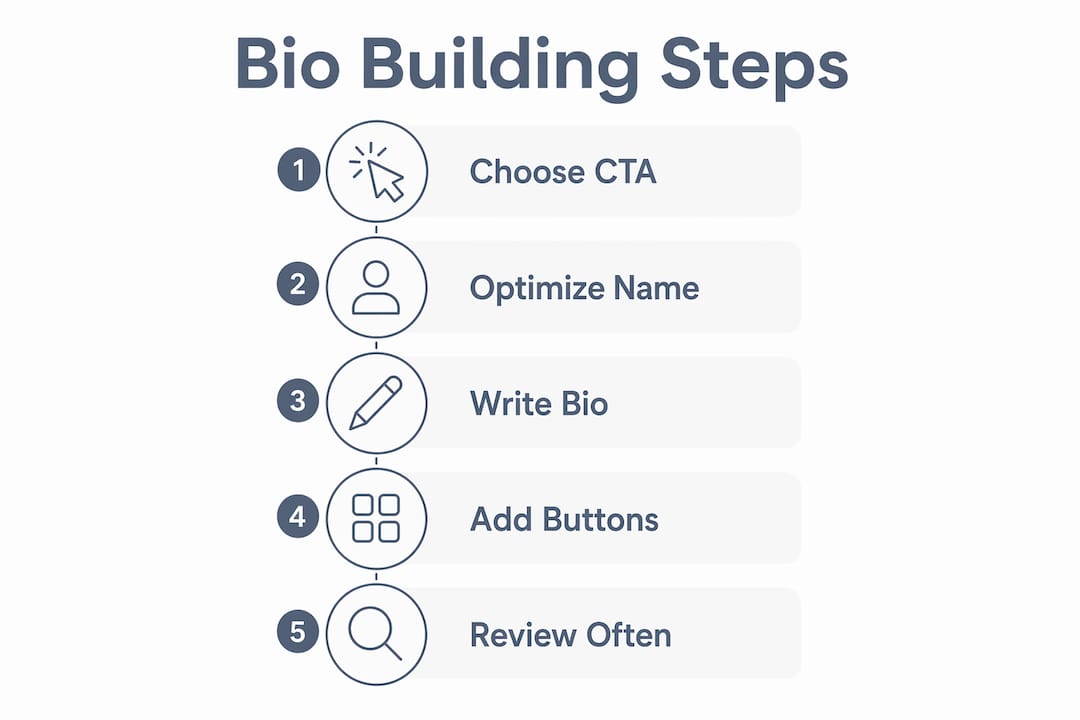
- Build or update your bio in five steps
- Key takeaways
- What most venues get wrong about their Instagram profile
- How Bridge PR helps Queensland venues get more from Instagram
- Useful sources
- FAQ
What should every restaurant Instagram bio include?
Think of your profile as your digital front door. A potential diner lands there and decides in seconds whether to book or bounce. These are the fields that do the work.
Name field
Put your restaurant name plus a neighbourhood or category here. "Ember Kitchen | South Bank Fine Dining" will surface in local searches that your bio text alone won't catch. This single tweak is one of the most effective ways to improve local discoverability on the platform.
Bio text (the 150 characters)
Prioritise utility over poetry. The 150-character limit is best used for cuisine type, suburb, a USP or signature dish, and a directional CTA. Anything else is noise.
| Bio element | What to write | Example |
|---|---|---|
| Cuisine / what you are | One short descriptor | "Modern Japanese small plates" |
| Location | Suburb or precinct | "Newstead, Brisbane" |
| USP or signature dish | One concrete hook | "Home of the 12-hour brisket" |
| Hours hint | Optional, brief | "Open The–Sun from 11am" |
| CTA line | Points to the link | "Book or order below " |
Business features: action buttons and contact fields
Use Instagram's built-in action buttons — Reserve, Order Food, Email, Call, Directions — to surface contact points without burning bio characters. A visitor can tap "Reserve" directly from your profile without you spending a single character on a phone number.
Pro Tip: Set your business category in Instagram settings (e.g. "Restaurant" or "Café"). It displays just below your name and acts as a free descriptor, freeing up bio space for your actual hook.
What CTA and link strategy works for Australian venues?
The bio link is the only clickable URL on your Instagram profile, so it needs to earn its place. Decide your primary action first, then build the link around it.
- Book first: If reservations drive revenue, link directly to your booking page (ResDiary, Quandoo, or your own site's booking widget). Fewer taps means more completions.
- Order first: If takeaway or delivery is the priority, link to your ordering page or a delivery aggregator landing page.
- Multiple actions: Use a link-in-bio hub — tools like Linktree, Milkshake, or a custom landing page — to surface bookings, the menu, and ordering in one place.
For most Queensland venues, a simple two-button page (Book a Table / Order Online) outperforms a long link hub. The fewer decisions a diner has to make, the better.
Add UTM parameters to every bio link: ?utm_source=instagram&utm_medium=bio&utm_campaign=bookings. That way Google Analytics or your booking platform shows you exactly how many visits and conversions came from Instagram. Check it monthly, not weekly — bio traffic needs time to accumulate a meaningful sample.
Pro Tip: Shorten your UTM-tagged URL with Bitly or a custom short domain before pasting it into the bio. Long URLs look cluttered and erode trust on mobile.
How should your bio tone match your venue's brand?
Short, human and relevant copy consistently outperforms clever wordplay that obscures what you actually are. That said, tone should match the room.
- Cafés: Warm, approachable, a little playful. "Good coffee, better mornings" works because it's specific and human. Avoid corporate language.
- Fine dining: Concise and considered. Every word should feel deliberate. Skip emojis or use one at most. "Contemporary Australian cuisine, Fortitude Valley" is enough.
- Bars: Playful and social. Funny Instagram bios for eateries and bars land well here — a dry one-liner followed by a booking link converts better than a list of spirits.
- Takeaway: Speed and convenience are the message. Lead with cuisine, follow with ordering CTA. No fluff.
Consistency between your bio, your Highlight covers, and your post captions is what builds trust. A potential guest who sees mismatched tones — formal bio, chaotic captions, unlabelled Highlights — will hesitate. Visual consistency across lighting, presets, and Highlight covers signals a venue that has its act together.
Ready-to-use bio templates for Australian venues
Copy, adapt, and paste. The character counts below include spaces and emojis.
| Template | Annotation + approx. character count |
|---|---|
| ☕ Specialty coffee & all-day brunch | Paddington, Brisbane |
| Casual eats, cold beers & good company | Fortitude Valley |
| Contemporary Australian cuisine | South Bank |
| Handcrafted cocktails & late nights | Newstead |
| Fresh Thai, fast | West End, QLD |
Pair each template with the matching action button (Reserve or Order Food) and a UTM-tagged link. For local relevance, swap generic suburb names for your actual precinct — "Fortitude Valley" or "Noosa Junction" reads more credibly to a Brisbane or Sunshine Coast diner than "Brisbane CBD."
For inspiration on how local food guides use neighbourhood references to drive discovery, the Dartmouth local food guide shows how specific location framing builds trust with nearby diners.
How do you measure and improve your bio's performance?
You cannot improve what you do not track. These are the four numbers worth watching in Instagram Insights and your booking platform:
- Profile visits — how many people land on your profile from posts, Reels, and search.
- Link clicks — taps on the bio link, visible in Instagram Insights under "Profile activity."
- Reservation or order clicks — tracked via your booking platform's UTM report or Bitly dashboard.
- Direction taps — if you have a business address set, Instagram tracks taps on the Directions button.
Run one change at a time. Swap the CTA line, wait 2–4 weeks, then compare link clicks against your baseline. Changing the link and the CTA simultaneously makes it impossible to know which variable moved the needle.
Refresh the bio for seasonal shifts, new menu launches, and events. A bio that still references a summer menu in July is a small but visible signal that the account is not actively managed. Venues that use Highlights and campaigns to promote events and competitions can mirror that messaging in the bio for a short window, then revert to the evergreen version.
A reasonable cadence: review the bio every 6–8 weeks, and update it immediately whenever a major menu change or event warrants it.
Build or update your bio in five steps
| Step | Field to edit | Short example |
|---|---|---|
| 1. Decide your primary CTA | Bio link destination | Direct booking page or link hub |
| 2. Write a one-line descriptor | Bio text, line 1 | "Modern Japanese small plates, Newstead" |
| 3. Add location + USP | Bio text, line 2 | "Home of the 12-hour brisket |
| 4. Set action button | Profile settings → Action Buttons | Reserve / Order Food |
| 5. Add UTM link + test | Bio link field | Bitly short link with UTM parameters |
Before you publish, run three quick checks: search your restaurant name in Instagram to confirm the Name field surfaces correctly, tap the bio link on mobile to confirm it loads fast, and read the full bio on a phone screen to check line breaks and emoji rendering.
Key takeaways
A restaurant's Instagram bio works when it combines a keyword-rich Name field, a utility-focused 150-character bio, and a single UTM-tracked link pointing to your primary revenue action.
| Point | Details |
|---|---|
| Name field is your search lever | Add suburb or category to the Name field to improve Instagram local search visibility. |
| 150 characters, one job | Use bio text for cuisine, location, USP, and a CTA — nothing else. |
| One link, tracked | Point the bio link to your booking or ordering page and tag it with UTM parameters. |
| Test one change at a time | Run each bio variation for 2–4 weeks before comparing link clicks and reservation taps. |
| Bridge PR for ongoing optimisation | Bridge PR's subscription packages cover profile strategy, content creation, and influencer campaigns for Queensland venues. |
What most venues get wrong about their Instagram profile
The conventional wisdom is that a clever, witty bio wins followers. It doesn't. What wins bookings is clarity. The venues I see consistently convert Instagram traffic into seated covers are the ones that treat the bio like a signpost, not a tagline competition. They name the suburb, state the cuisine, and point to a booking page. That's the whole strategy.
Where things get interesting is in the consistency layer. A bio that says "refined modern Australian" paired with chaotic, unedited food photos creates cognitive dissonance. The diner's brain registers the mismatch even if they can't articulate it, and they scroll on. The bio is only as strong as the profile it sits on top of. Restaurant Instagram captions, Highlight covers, and post frequency all feed the same trust signal.
The other thing most guides skip: the Name field is doing more SEO work than the bio text. Fixing that one field takes 30 seconds and can meaningfully shift how often your profile appears in local search results. Do it before anything else.
How Bridge PR helps Queensland venues get more from Instagram
Writing a strong bio is the starting point. Keeping the whole profile working — consistent content, credible influencer partnerships, and campaigns that actually drive covers — is where most venue owners run out of time.
Bridge PR's subscription packages for Queensland restaurants, cafés and bars cover exactly that gap: monthly social content creation, venue positioning strategy, microinfluencer collaboration management, and PR-style storytelling that builds the kind of profile people trust before they book. No one-size-fits-all templates, no offshore content farms. Local food creators, local knowledge, commercially focused outcomes.
If you want a profile that works as hard as your kitchen does, see what Bridge PR offers and get in touch to discuss a package that fits your venue.
Useful sources
The recommendations in this article draw on published guidance from hospitality marketing practitioners and Instagram strategy resources. Key sources:
- Instagram for Restaurants: 10 proven tips to grow your business — Name field search optimisation, profile-as-front-door framing, and consistency between bio and posts.
- How restaurants should use Instagram — 150-character utility principle, link-in-bio conversion strategy, and booking/ordering link guidance.
- Instagram bio tips for restaurants — Action buttons and contact fields to keep bio text clean.
- 216 Best Restaurant Captions for Instagram — Hashtag best practice (3–5 targeted tags) and caption tone guidance.
- 100+ Irresistible Instagram Captions for Restaurants — Visual consistency and branded profile advice.
FAQ
What should a restaurant put in its Instagram bio?
Include your cuisine type, suburb, a one-line USP or signature dish, and a CTA pointing to your booking or ordering link. Keep it under 150 characters and use Instagram's action buttons for contact details.
How do you make a restaurant bio searchable on Instagram?
Add your restaurant name plus a location or category word to the Name field — not just the bio text. Instagram's internal search reads the Name field heavily, so "Ember Kitchen | South Bank Fine Dining" will surface in local searches more reliably than a bio-only mention.
How often should a restaurant update its Instagram bio?
Review it every 6–8 weeks and update immediately for major menu changes, seasonal promotions, or events. A bio referencing an outdated promotion signals an unmanaged account to potential diners.
Can Bridge PR help with Instagram profile strategy?
Yes. Bridge PR's subscription packages for Queensland venues include social profile optimisation, content creation, and influencer collaboration management as part of an integrated hospitality marketing approach.
How many hashtags should a restaurant use on Instagram?
Industry guidance recommends 3–5 hashtags per post, prioritising local and niche food tags over volume. Relevance to your suburb and cuisine outperforms hitting a high hashtag count.