
Restaurant review management is the tactical system that collects, monitors, responds to and amplifies guest feedback to protect your venue's reputation and drive real bookings. It sits inside the broader discipline of reputation management, but where reputation management is strategic, review management is tactical — it's the daily and weekly work that keeps your venue visible, credible and competitive.
96% of consumers read online reviews before choosing a local business, and the ACCC has clear rules about how you can and cannot collect them.
Start this week:
-
Claim and verify your Google Business Profile if you haven't already
-
Set up a TripAdvisor listing and respond to your three most recent reviews
-
Add a QR code to your receipt or table card that links directly to your Google review page
-
Check your ACCC obligations on review collection (no fake or incentivised reviews)
-
Contact Bridge PR if you want a specialist to run the whole system for you
Table of Contents
- How do you build a restaurant review management system?
- Which review platforms matter most for Australian venues?
- What are the legal and ethical rules for collecting reviews in Australia?
- What KPIs and timelines should you track?
- How do you turn reviews into marketing assets?
- When should you hire a specialist agency?
- Key takeaways
- Why most venues are leaving reviews on the table
- Bridge PR helps your venue build a reputation worth talking about
- Useful sources
- FAQ
How do you build a restaurant review management system?
A repeatable system has five stages: collect, monitor, respond, escalate and amplify.
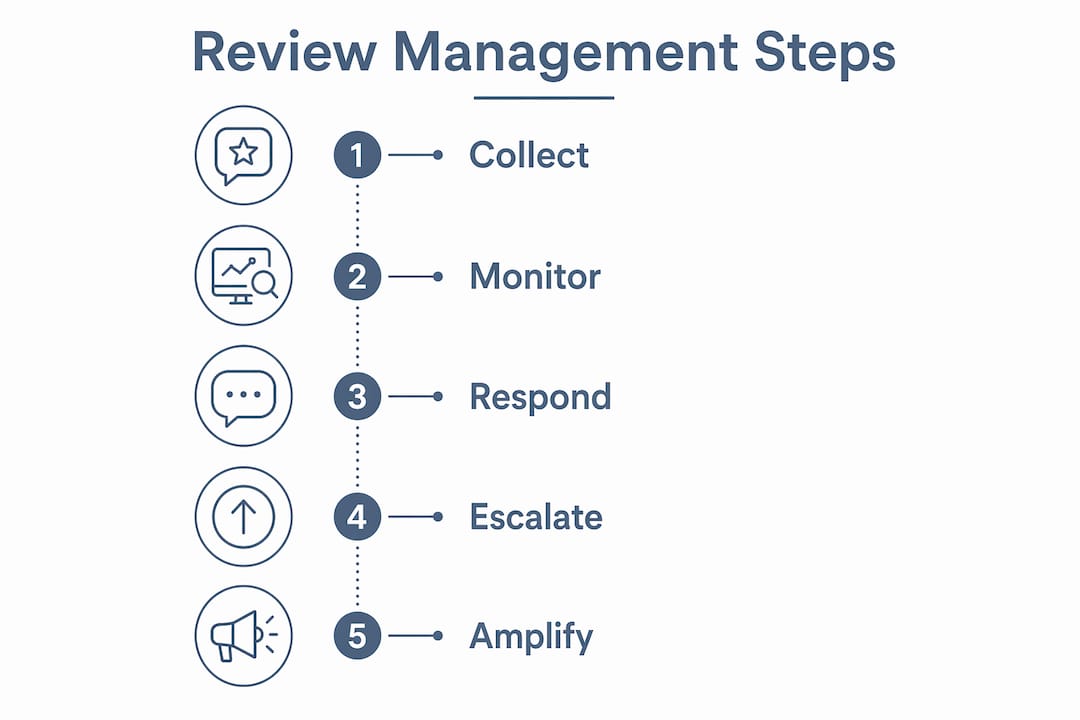
1. Collect
Timing is everything. Automated review requests sent 30–60 minutes after a transaction, via SMS or a short in-app prompt, produce the highest conversion to written reviews. A QR code on the receipt or a table card works well for dine-in. For delivery orders, a follow-up SMS through your POS is the cleanest trigger.
Keep it compliant: never offer a discount or gift in exchange for a review, and never ask only happy customers (that's called review gating, and it violates both ACCC guidance and platform policies).
2. Monitor
Consolidate everything into one dashboard. Tools like Birdeye monitor 200+ review sites and integrate with your CRM or POS, so you see every mention in one place. Set up email or push notifications for any review under four stars so nothing slips through overnight.

A 24-hour response SLA for public reviews is the industry standard. Miss that window and the review sits unanswered in front of every future customer who searches your venue.
3. Respond
Keep responses short, specific and on-brand. Here are three micro-templates:
| Review type | Template |
|---|---|
| Positive | "Thanks so much, [Name] — so glad you loved the [dish]. We'll pass that on to the team. Hope to see you again soon." |
| Neutral | "Thanks for the feedback, [Name]. We're glad parts of the experience worked for you — we'll look into [specific issue] and appreciate you letting us know." |
| Negative | "We're sorry to hear this, [Name]. This isn't the experience we want for anyone. Please reach out to us directly at [email] so we can make it right." |
Pro Tip: Personalise every response with the reviewer's name and one specific detail from their review. Generic replies read as copy-paste and damage trust more than no reply at all.
4. Escalate
Not every review needs a manager. Escalate to the owner or a PR partner when: the review contains a legal threat or defamation claim; the review is gaining social traction (shares, comments); a food safety allegation appears; or a cluster of negative reviews arrives in a short window (a potential coordinated attack). At that point, a retained partner like Bridge PR can step in with a crisis response protocol before the situation compounds.
5. Amplify
Genuine five-star reviews are marketing assets. Screenshot and share them on Instagram Stories, embed them on your website booking page, and pull the best quotes into your email newsletter. Paid social ads built around real customer quotes consistently outperform generic creative.
Which review platforms matter most for Australian venues?
Focus your effort in this order:
- Google Business Profile — the highest-priority platform for every venue. Google reviews directly influence local search rankings and appear in Maps results. Claim your listing, add photos weekly, and respond to every review.
- TripAdvisor — critical for venues that attract tourists or appear in "best of" searches. Fewer than 1% of listings across 8 million properties achieve Travelers' Choice Best of the Best status, which requires sustained review volume over 12 months. Even reaching the top tier of your suburb is a meaningful differentiator.
- Meta (Facebook/Instagram) — Facebook reviews feed into local search and are visible on your business page. Instagram UGC (tagged posts, Stories, Reels) functions as social proof even without a formal star rating.
- OpenTable — if you take reservations through OpenTable, verified diner reviews appear on your listing and carry high credibility because they're tied to actual bookings.
- Uber Eats / DoorDash — delivery platform ratings affect your ranking within the app. A low rating on Uber Eats can suppress your venue in search results for thousands of potential customers who never visit your website.
What are the legal and ethical rules for collecting reviews in Australia?
The ACCC treats fake or misleading reviews as a breach of the Australian Consumer Law. That means no paying for positive reviews, no creating fake reviewer accounts, and no suppressing negative feedback by only asking customers you know are happy.
The ACCC's position is clear: businesses must not publish or engage with reviews they know to be false or misleading, and must not offer incentives for reviews without clear disclosure. Influencer and creator posts that promote your venue must include a disclosure (e.g. #ad or #gifted) if the visit was hosted or paid for. Failing to disclose is a breach of both ACCC guidance and platform policies.
Do:
- Ask all customers for honest feedback, regardless of what you expect them to say
- Disclose any hosted or gifted experience in influencer content
- Request removal of reviews that contain defamatory content or violate platform policies through the platform's official dispute process
Don't:
- Offer discounts, free meals or gifts in exchange for a positive review
- Gate reviews by pre-screening sentiment before sending a review link
- Respond to a negative review with threats or personal attacks
For defamatory reviews, start with a formal takedown request through the platform. If the review remains and causes demonstrable harm, seek legal advice from a solicitor experienced in Australian defamation law before escalating further.
What KPIs and timelines should you track?
Core metrics to watch monthly:
- Review volume — total new reviews across all platforms
- Average rating — track per platform, not just overall
- Response rate and time — aim for 100% response rate within 24 hours
- Review velocity — the pace of incoming reviews; a measurable local SEO signal that often matters more than total count
- Conversion lift — track whether embedding reviews on your booking page improves reservation completions
Realistic timeline:
- 0–3 months: Claim listings, set up monitoring, establish response cadence. Expect review volume to increase as you start asking consistently.
- 3–6 months: Average rating stabilises or improves. Response rate hits target. Review velocity becomes a trackable trend.
- 6–12 months: Compounding effect on local search visibility. Embedded reviews lift conversion. You have enough content to run review-led paid social campaigns.
Stat to know: Fewer than 1% of TripAdvisor's 8 million listings achieve Best of the Best status. You don't need to be in that 1% — but understanding the benchmark shows how much sustained effort separates the top venues from the rest.
Budget for review management tools and response time can vary depending on venue size and activity level. A retained agency like Bridge PR covers strategy, execution and influencer management within a monthly subscription.
How do you turn reviews into marketing assets?
Authentic reviews improve conversion and reduce bounce rates when embedded at the point of decision. Here's how to put them to work:
- Website: Embed a Google or TripAdvisor review widget on your homepage and booking page
- Social carousels: Pull three to five quotes into a branded Instagram carousel post
- Paid ads: Use real customer quotes as ad copy on Meta; these consistently outperform venue-produced copy
- Email: Feature a recent five-star review in your monthly newsletter or event promo
- Creator integration: When a food influencer posts about your venue, pair their content with organic reviews in the same campaign to reinforce credibility
A practical campaign structure: a Brisbane café runs a creator visit, the creator posts a Reel, and the venue simultaneously shares three recent Google reviews in a Story series. The combined reach of creator content plus verified reviews gives potential customers both aspiration and social proof at the same moment.
Pro Tip: When selecting reviews to amplify, choose ones that mention a specific dish, experience or staff member. Vague praise ("great place!") carries far less weight than a review that names your signature dish and describes the atmosphere.
When should you hire a specialist agency?
Hire a retained partner when any of these apply:
- You're receiving more than 20 reviews per month and can't respond within 24 hours
- Your average Google rating has dropped below 4.0 and you don't know why
- You're opening a second location and need consistent brand voice across both
- A negative review has gone viral or attracted media attention
- You want to run influencer campaigns but have no process for managing creators
A specialist agency like Bridge PR covers: review strategy and governance, response templates and approval workflows, influencer talent management, PR storytelling, paid social amplification, and crisis protocols. The Birdeye enterprise model shows how AI-drafted responses plus human approval keeps replies fast and authentic — Bridge PR applies the same principle at the venue level.
What to look for when selecting an agency:
- Clear monthly deliverables and reporting
- Experience in Australian hospitality (not just generic digital marketing)
- Influencer relationships in your city or region
- A defined crisis escalation process
- Transparent subscription pricing with no lock-in contracts
Onboarding milestones to expect: Week 1: audit of existing listings and review history. Week 2: response templates approved and monitoring set up. Week 4: first influencer brief drafted. Month 2: first campaign live.
Key takeaways
Consistent restaurant review management, combining daily monitoring, fast responses and deliberate amplification, is one of the highest-return marketing activities available to Australian venues in 2026.
| Point | Details |
|---|---|
| Start with Google | Claim your Google Business Profile first; it has the greatest impact on local search and bookings. |
| Time your requests | Send review requests 30–60 minutes after a transaction for the highest conversion to written reviews. |
| Track review velocity | Review velocity is a local SEO signal; set a monthly target and monitor it alongside average rating. |
| Amplify what works | Embed genuine reviews on your booking page and use real customer quotes in paid social ads. |
| Bridge PR | When review volume or influencer campaigns exceed your internal capacity, Bridge PR's monthly subscription covers strategy, response governance and creator management. |
Why most venues are leaving reviews on the table
The conventional wisdom is that review management is about damage control: respond to the bad ones, thank the good ones, move on. That framing misses the point entirely.
The venues that win the local search and booking game in Queensland treat every review as a data point and a content asset simultaneously. A negative review tells you something your front-of-house manager might not. A five-star review that names a specific dish is free ad copy. A cluster of reviews mentioning the same problem is an operational brief.
What most owners underestimate is the compounding effect. A venue that responds consistently, requests reviews at the right moment and repurposes the best ones into paid creative will outperform a venue with a higher baseline rating that does nothing with its reviews. The gap widens every month.
The other thing worth saying: the influencer and UGC layer is not separate from review management. It feeds it. A creator visit that generates 40 tagged posts also tends to generate a spike in organic Google reviews from the people who saw those posts and then visited. That's not coincidence — it's how modern discovery works in the Australian hospitality market.
Bridge PR helps your venue build a reputation worth talking about
Running a review system, managing creator relationships and keeping your Google rating climbing is a full-time job on top of running a venue. Bridge PR's monthly subscription packages are built specifically for Queensland restaurants, cafés and bars that want all of it handled without hiring an in-house marketing team.
The subscription covers review strategy and response governance, influencer and microinfluencer collaboration management, PR-style content creation, and paid social support — all under one monthly fee with no long-term contracts. Onboarding takes two weeks, and most venues see measurable improvement in review velocity within the first 60 days.
Book a discovery call with the Bridge PR team to get a complimentary audit of your current review presence and a clear picture of where the gaps are.
Useful sources
- BrightLocal: What is Online Review Management? — Solid primer on the distinction between review management and reputation management, plus consumer behaviour data on how reviews influence purchasing decisions.
- Birdeye: Review Management Guide — Covers enterprise-level governance, AI-assisted response workflows, and how review management protects revenue. Useful for multi-location venues.
- ReviewTrackers: Online Review Management — Practical guidance on treating reviews as marketing assets, including embedding and syndication strategies.
- TripAdvisor Travelers' Choice — The benchmark for understanding what sustained review volume and quality looks like at the top of the market.
- ACCC: Fake reviews and testimonials — Search "ACCC fake reviews" on the ACCC website for the current guidance on misleading reviews and disclosure obligations under Australian Consumer Law.
FAQ
What is restaurant review management?
Restaurant review management is the tactical process of collecting, monitoring, responding to and amplifying guest reviews across platforms like Google, TripAdvisor and Meta. It differs from reputation management, which is broader and more strategic.
How quickly should a restaurant respond to reviews?
Respond to all public reviews within 24 hours. This applies to negative reviews especially, where a fast, calm response is visible to every future customer who reads the thread.
Can I offer a discount in exchange for a Google review?
No. The ACCC treats incentivised reviews as potentially misleading conduct under Australian Consumer Law, and Google's platform policies prohibit offering rewards in exchange for reviews.
How does review velocity affect my restaurant's search ranking?
Review velocity — the rate at which new reviews arrive — is a local SEO signal. A steady flow of recent reviews signals to Google that your venue is active and relevant, which can improve your position in local search results.
When should I hire an agency to manage my restaurant's reviews?
Hire a specialist when you can't respond within 24 hours, your rating has dropped below 4.0, you're managing multiple locations, or a review has attracted media attention. Bridge PR's monthly subscription covers review governance, influencer management and crisis response for Queensland venues.