Facebook ads for restaurants work. Not in a vague "brand awareness" way, but in a measurable, people-in-seats way. The key is structure: a full-funnel approach using Reels for awareness, carousel ads to showcase your menu, and Lead Ads to capture reservations converts local diners far more efficiently than boosted posts ever will.
For Queensland restaurant and café owners, the setup that consistently performs uses a radius around your venue targeting "People living in or recently in this location," with budgets starting at a moderate monthly amount spread across awareness, conversion, and retargeting campaigns. Restaurants are among the best-suited industries for Meta advertising because food is visual, the decision to try somewhere new is low-commitment, and your customer base is geographically defined.
- Platforms: Facebook and Instagram, managed through a single Meta Ads Manager account
- Top formats: Reels video (awareness), carousel ads (menu consideration), Lead Ads (reservations)
- Targeting: 3–8 km radius, "People living in or recently in this location"
- Budget starting point: an affordable monthly budget for a single location
- Split: a budget allocation with the greatest focus on awareness, followed by conversion and retargeting
- Creative: real food photography or short vertical video with a tangible offer
Pro Tip: Never use the "Boost Post" button. It defaults to an engagement objective and targets too broadly. Build every campaign in Meta Ads Manager so you control objectives, placements, and budget.
How to set up a Facebook ad campaign for your restaurant
Step 1: Install the Meta Pixel
Before you spend a dollar, install the Meta Pixel on your website or online ordering system. Without it, Meta cannot track conversions, build retargeting audiences, or optimize delivery. It is the foundation everything else runs on.
Step 2: Choose your campaign objective
Open Meta Ads Manager and create a new campaign. Match the objective to the outcome you want: Awareness for Reels reach, Traffic for menu page clicks, or Leads for reservation capture. Each objective tells Meta's algorithm what to optimize for, and picking the wrong one wastes budget fast.
Step 3: Set your location targeting
Under Audience, go to Locations and select "People living in or recently in this location." Set a 3–8 km radius around your venue. Dense urban spots like Brisbane's inner suburbs perform well at 3–4 km; suburban Queensland venues typically need 5–8 km to reach enough people.
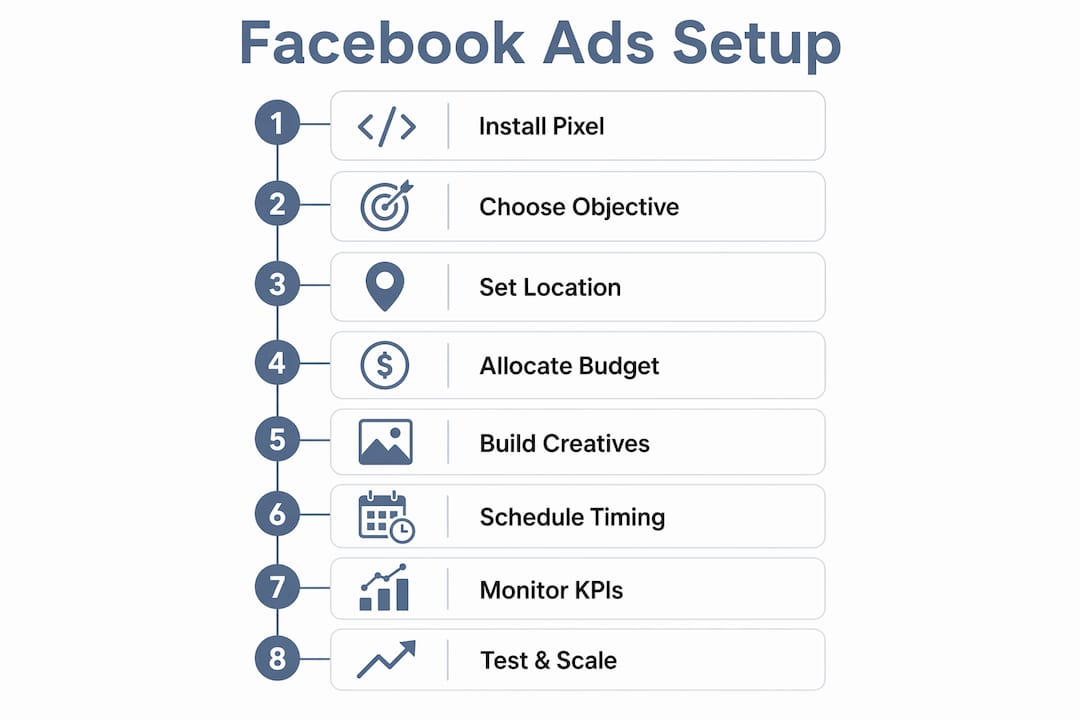
Step 4: Allocate your budget
For a single-location restaurant, split your monthly budget roughly 50% to awareness campaigns, 30% to conversion (Lead Ads), and 20% to retargeting. This structure keeps new people entering your funnel while converting the ones already familiar with you.
Step 5: Build your creative assets
Short vertical videos (15–30 seconds) for Reels, carousel ads showing 3–5 menu items, and single-image ads with a clear offer. Every creative needs a call-to-action: "Book Now," "Order Online," or "See This Week's Special."
Step 6: Schedule for peak meal times
Run ads during lunch 11 AM–1 PM and dinner 5 PM–8 PM. Paying for impressions at 3 AM when nobody is deciding where to eat is money you will not get back.
Step 7: Monitor your KPIs
Check Meta Ads Manager weekly. The metrics that matter for restaurants: cost per lead, click-through rate, and frequency. If frequency climbs above 5–6 impressions per person per week, your audience is too small or your creative needs refreshing.
Step 8: Test and scale
Run A/B tests on your offer and creative. When one ad set outperforms, shift budget toward it. Pause anything that has run two weeks without hitting your cost-per-lead target.
Local Queensland provider: MetaPixels
One Queensland-based option worth knowing for restaurant owners who want their paid social campaigns backed by a proper online ordering setup is MetaPixels.
| Provider | Services offered | Specialization | Pricing transparency | Rating |
|---|---|---|---|---|
| MetaPixels | Restaurant portals, ecommerce stores, custom website development | Commission-free online ordering, SEO-friendly restaurant sites | Affordable, transparent, project-based | 5★ (17 reviews) |
MetaPixels builds commission-free online ordering portals and SEO-friendly websites specifically for restaurants. For Facebook ad campaigns that drive traffic to a direct ordering page rather than a third-party platform like Uber Eats, having your own ordering system matters. Third-party delivery commissions run 15–30%, so every direct order your ads generate is a meaningfully more profitable transaction. MetaPixels' project-based pricing model means you know the cost upfront, with no ongoing platform fees eating into your margins.
8 ways to get more from your restaurant Facebook ads
1. Build a full funnel, not just one campaign. Reels for reach, carousel for consideration, Lead Ads for bookings. Each stage does a different job, and running only one of them leaves conversions on the table.

2. Drop boosted posts entirely. Ads Manager campaigns give you explicit objectives, audience controls, and real reporting. Boosted posts give you likes.
3. Use hyper-local targeting. Urban venues in Brisbane or the Gold Coast: 3–4 km. Suburban or regional Queensland: 5–8 km. Broader than that and you are paying to reach people who will never drive to you.
4. Lead with a tangible offer, not your logo. Offer-focused creatives stop the scroll. "Tuesday night pasta special, $22" outperforms "Come experience our authentic Italian kitchen" every time. The offer is the hook; the experience is what brings them back.
5. Shoot vertical video on your phone. User-generated content style Reels ads consistently outperform polished studio footage for restaurant audiences. A 15-second clip of a dish being plated in natural light is enough.
6. Retarget warm audiences with something specific. Anyone who visited your website or engaged with your Instagram in the last 90 days already knows you. Retargeting these people with a weekend special or new menu item converts at dramatically lower cost than cold prospecting.
7. Track the right numbers. Cost per lead, CTR, and frequency are your weekly dashboard. Restaurants achieve a high conversion rate on Facebook Lead Ads, among the best of any industry, so if your numbers are well below that benchmark, the issue is usually the offer or the targeting radius.
8. Cap frequency. Once someone has seen your ad 5–6 times in a week, additional impressions generate irritation, not bookings. Widen your audience or refresh the creative.
Pro Tip: Use Lead Ads for reservation capture. The pre-filled form opens inside the Facebook app, so customers never leave Meta to complete a booking. Completion rates are significantly higher than sending traffic to a third-party reservation page.
Common mistakes that kill restaurant ad campaigns
Running ads without the Meta Pixel installed is the most expensive mistake. Without it, Meta has no conversion data to optimize against, retargeting audiences cannot be built, and you are essentially flying blind.
Targeting too broadly or too narrowly both hurt. A 50 km radius for a Fortitude Valley café wastes budget on people in Ipswich. A 1 km radius with four interest layers gives Meta's algorithm no room to find your best customers. The middle ground, a clean radius with minimal interest stacking, usually outperforms.
Quitting after two weeks is the other common failure. Meta's algorithm needs at least 3–5 days to exit the learning phase, and most campaigns need 2–4 weeks of data before meaningful optimization is possible. Restaurants that run ads for a month, see modest results, and stop lose all the audience data they built.
Legal and compliance considerations for food and alcohol advertising in Australia
Australian food advertising must comply with the Australian Consumer Law, which prohibits misleading claims about ingredients, health benefits, or pricing. Any promotional price must be the genuine price, and "limited time" offers must actually be limited.
Alcohol advertising on Meta requires age-gating. Set your audience minimum to 18+ for any ad featuring alcohol, and include a responsible service of alcohol message where required by Queensland liquor licensing conditions. The Queensland Office of Liquor and Gaming Regulation sets the specific rules for licensed venues, and Meta's own advertising policies layer on top of those.
Health claims about food, such as "low calorie" or "heart healthy," trigger additional obligations under Food Standards Australia New Zealand (FSANZ) standards. If your ad copy makes a nutrition claim, it must meet the definitions in Standard 1.2.7 of the Food Standards Code.
Connecting Facebook ads to your reservation and ordering systems
The most direct integration is installing the Meta Pixel on your booking or ordering page and creating a custom conversion event for completed reservations or orders. This lets Meta optimize delivery toward people most likely to complete the action, not just click.
For reservation platforms common in Australia, such as OpenTable or Resy, check whether they support Pixel integration or offer a direct URL to your booking page. Sending ad traffic to your homepage instead of the booking page adds unnecessary friction and drops conversion rates noticeably.
For direct online ordering, platforms like paid social strategies that mirror hospitality full-funnel thinking apply equally here: drive traffic to the ordering page, not the homepage, and retarget anyone who visited but did not complete an order.
What successful Australian restaurant ad campaigns look like
A café in Arizona running a comparable campaign on a moderate budget used a single irresistible offer, a 20% discount shown at the counter, combined with a 15-second Instagram Reel and a carousel of drinks and pastries. Walk-in traffic increased notably over the campaign period, and the offer was redeemed many times in the first few weeks.
A separate café case study using a moderate monthly budget tested a low-priced breakfast sandwich offer. The campaign ran entirely on Meta with local targeting and simple creative. The sandwich became a popular item, and the foot traffic it generated converted into coffee sales without any discount on the core product.
Both examples share the same structure: a specific, tangible offer, hyper-local targeting, and vertical video or carousel creative. Neither relied on polished production or large budgets.
How to choose a Facebook ad agency for your restaurant in Queensland
The right agency for restaurant Facebook advertising understands hospitality, not just ad platforms. Ask any prospective agency whether they have run campaigns specifically for food and beverage venues, and ask to see cost-per-lead benchmarks from those campaigns.
Prioritize agencies that build in Meta Ads Manager rather than relying on boosted posts, and that can demonstrate a full-funnel structure across awareness, conversion, and retargeting. An agency that cannot explain the difference between a Lead Ad and a Traffic campaign is not the right fit.
Local Queensland presence helps when your campaigns need to reflect seasonal events, local food culture, or Queensland-specific promotions. Remote agencies can run technically sound campaigns, but local context shows up in the creative.
Bridgepr pairs paid ads with content that makes people want to visit
Running Facebook and Instagram ads gets people to notice your venue. What makes them book, share, and come back is the content and story behind the ads. That is where Bridgepr comes in.
Bridgepr works with Queensland restaurants, cafés, and bars on the content strategy, food creator partnerships, and influencer collaborations that make paid social campaigns actually land. Instead of running ads against generic food photography, Bridgepr's subscription packages build the credible, local content that stops the scroll and earns the booking. The result is paid and organic working together, not separately.
If your Facebook ads are generating clicks but not the kind of venue reputation that fills seats on a Tuesday, explore Bridgepr's hospitality packages and see what a content-first approach adds to your paid strategy.
Key Takeaways
Facebook ads for restaurants deliver the strongest results when campaigns are built around a clear funnel, local targeting, and offer-driven creative rather than generic brand content.
| Point | Details |
|---|---|
| Full-funnel structure | Use Reels for awareness, carousel for menu consideration, and Lead Ads for reservation capture. |
| Local targeting radius | Set a 3–8 km radius using "People living in or recently in this location" for genuine local reach. |
| Budget allocation | Single-location restaurants start at AU$450–1,200/month, split 50% awareness, 30% conversion, 20% retargeting. |
| Lead Ad performance | Restaurants achieve a high conversion rate on Facebook Lead Ads, among the best of any industry. |
| Bridgepr | Bridgepr pairs paid social support with food creator content and influencer campaigns for Queensland venues. |