
TL;DR:
- Using Google Ads captures guests searching for immediate reservations, while Meta builds awareness and retargets interested audiences. A combined strategy with both platforms and proper tracking typically yields faster bookings and sustained customer flow. Bridge PR offers all-in-one agency services, including creative production and campaign management, to streamline hospitality marketing efforts.
Use Google Ads to capture guests who are already searching for a table tonight. Use Meta (Facebook and Instagram) to make sure they already know your name when they do. Run both as one system, not two separate experiments.

For a small Brisbane venue, a practical starting split is roughly 60% of your paid budget on Google Search (capturing immediate booking intent) and 40% on Meta (prospecting and retargeting). Google Search captures high-intent traffic ready to act, while Meta builds the discovery layer that fills your retargeting pool.
Quick-start checklist for this week:
- Set up a Google Search campaign targeting "[your suburb] restaurant booking" and similar phrases
- Install the Meta pixel and Conversions API on your booking page
- Repurpose your three best food photos into a Meta prospecting ad set
- Connect your booking platform to Google Analytics 4 so table reservations register as conversions
Pro Tip: Don't wait until both platforms are "perfect" before spending. A $30/day Google Search campaign targeting your suburb will tell you more in two weeks than six months of planning.
Table of Contents
- How do Google Ads and Meta Ads compare for hospitality venues?
- How do Google and Meta map to your guest's journey?
- Campaign templates for restaurants, cafés and bars
- How do you track bookings across both platforms and your CRM?
- What budget and timeline should a Brisbane venue plan for?
- What creative actually lowers your cost per booking?
- Common mistakes Bridge PR sees in hospitality advertising
- Should you manage ads yourself or hire help?
- Key takeaways
- A local perspective from Bridge PR
- Bridge PR's hospitality marketing subscriptions
- Further reading and tools
- FAQ
How do Google Ads and Meta Ads compare for hospitality venues?
| Dimension | Google Ads | Meta (Facebook & Instagram) |
|---|---|---|
| Funnel stage | Intent to action | Awareness to consideration |
| Best formats | Search, Local, Performance Max | Reels, Stories, Feed video, Carousel |
| Targeting approach | Keywords and search intent | Interests, behaviour, lookalike audiences |
| Measurement | Search conversions, GA4, offline API | Meta pixel, Conversions API (CAPI), lift tests |
| Typical CPC | typically higher on Search | lower on Meta |
| Conversion speed | Hours to days | Days to weeks |
| Best use for a Brisbane venue | Dinner reservations, "near me" searches | Menu launches, event awareness, retargeting |
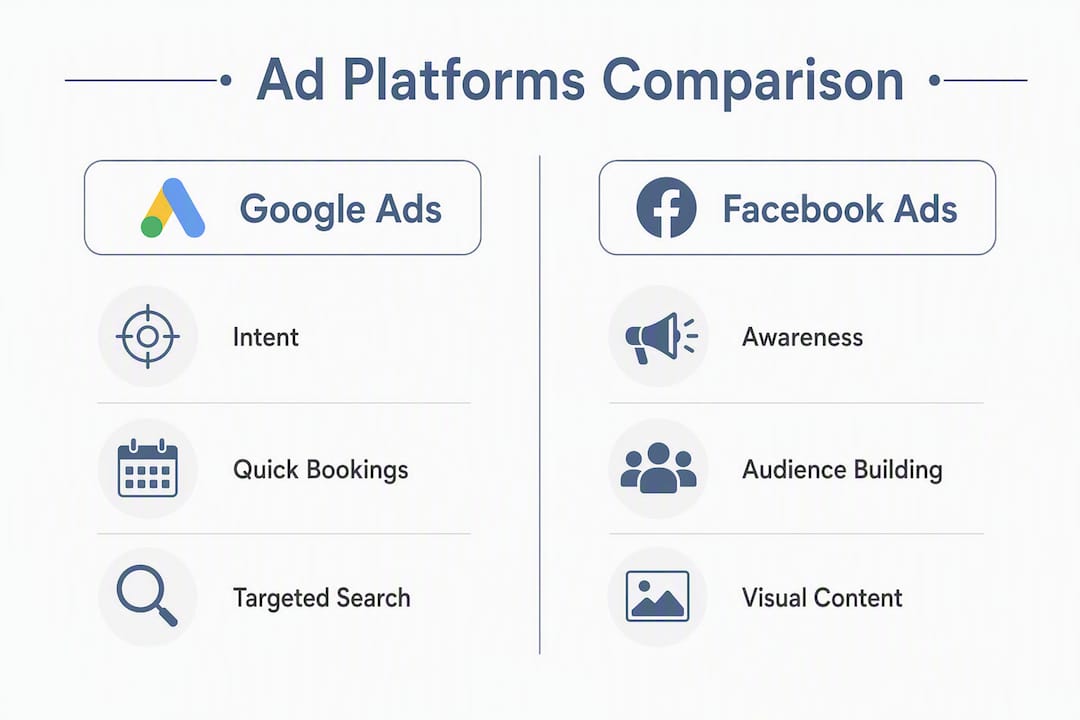
Meta's lower cost per click is a real observation, but lower CPC does not guarantee bookings. Google's higher CPC usually indicates stronger purchase intent: users searching specific restaurant queries are often closer to deciding. Meta reaches people mid-scroll, which is why creative quality matters so much more there.
For restaurants and cafés specifically:
- Google Local campaigns surface your venue in Maps results at the exact moment someone nearby is hungry
- Meta Reels work well for menu launches and seasonal specials because they feel native, not like ads
- Retargeting on Meta recaptures people who visited your website or booking page but didn't confirm
How do Google and Meta map to your guest's journey?
Think of it as a sequence, not a competition. Meta is the lure; Google is the net.
Awareness: Meta prospecting campaigns using Reels, Stories, and feed video introduce your venue to cold audiences. Optimise for video views or reach at this stage, not conversions.
Consideration: Meta lead forms, video ads showing the dining experience, and Instagram carousel posts of your menu move warm audiences toward intent. Google Display can reinforce here, but it's a secondary lever.
Intent: Google Search and Local campaigns capture guests actively searching for a venue. This is where your budget works hardest per dollar.
Action: Google branded search and Meta retargeting close the loop. Someone who saw your Reel three days ago and is now searching your name on Google is your highest-converting audience segment.
Pro Tip: Meta usually takes several days to a couple of weeks per user to move from awareness to booking. Google Search can convert on the same day. Budget accordingly: Google delivers faster early wins; Meta builds the pipeline that sustains them.
Campaign templates for restaurants, cafés and bars
Three ready-to-use templates
-
Dinner reservations (Google Search + Meta retargeting) Objective: bookings. Google Search targets "[suburb] restaurant dinner" and similar phrases. Meta retargets website visitors with a short video of the dining room and a direct booking link. KPI: cost per confirmed reservation under $15.
-
Weekend event or special (Meta prospecting + Google branded) Objective: ticket sales or covers. Meta Reels ad featuring influencer content from a previous event, targeted to a lookalike audience of past bookers. Google branded search captures anyone searching the event name after seeing the Reel. KPI: cost per ticket under $8.
-
Takeaway or pickup promo (Meta feed + Google Local) Objective: online orders. Meta carousel showing three hero dishes with a "order now" CTA. Google Local campaign targeting your suburb radius. KPI: cost per order under $6.
Influencer content workflow: License short-form clips from your influencer collaborations for paid use before the shoot. Use the raw footage as Meta prospecting creative, the edited clip as a Reel, and a still frame as a Google Display asset. Tag the booking link in every placement. This approach treats creative as a production system rather than a one-off task.
Setup checklist for every template:
- Dedicated landing page or booking widget (not your homepage)
- UTM parameters on every ad URL
- Meta pixel firing on booking confirmation page
- CAPI sending server-side booking events
- GA4 conversion event mapped to "reservation confirmed"
Pro Tip: For food influencer sourcing and licensing, the guide to finding food influencers for Australian brands covers the brief-to-licensing workflow in detail.
How do you track bookings across both platforms and your CRM?
Implementing CAPI and server-side events reduces pixel loss and gives Meta's algorithm the signal it needs to find guests who actually show up, not just click.
Step-by-step tracking setup:
- Install the Meta pixel on your website and verify it fires on the booking confirmation page
- Set up Conversions API (CAPI) via your booking platform's native integration or a server-side tag in Google Tag Manager
- Enable deduplication so browser and server events don't double-count
- Create a GA4 custom event ("reservation_confirmed") and import it into Google Ads as a conversion action
- Connect your booking platform (SevenRooms, ResDiary, or similar) to export completed reservations weekly
- Reconcile ad-platform reported conversions against actual covers in your POS or CRM monthly
| Tracking element | Tool | Frequency |
|---|---|---|
| Meta pixel health | Meta Events Manager | Weekly |
| CAPI event match quality | Meta Events Manager | Weekly |
| GA4 conversion events | GA4 + Google Ads | Weekly |
| CRM reconciliation | Booking platform export | Monthly |
Pro Tip: Reconcile weekly for the first month. Once your event match quality score in Meta Events Manager sits above 7.0, you can move to fortnightly checks.
What budget and timeline should a Brisbane venue plan for?
| Venue size | Monthly ad spend | Google split | Meta split | Learning phase |
|---|---|---|---|---|
| Small venues | modest monthly ad spend | majority Google | remainder Meta | learning phases last several weeks |
| Medium venues | moderate monthly ad spend | balanced Google and Meta | balanced Google and Meta | learning phases last several weeks |
| Larger or growth venues | higher monthly ad spend | smaller Google proportion | larger Meta proportion | shorter learning phase |
Meta prospecting requires a sustained budget to generate reliable signals; stopping early can distort results. Google Search exits its learning phase faster, typically 4–6 weeks, because search volume gives the algorithm more data sooner.
- Expect Google Search to show measurable booking lift within 4–6 weeks
- Expect Meta prospecting to show measurable lift after 6–12 weeks of consistent spend
- Judge early Meta results by cost per landing-page view and video completion rate, not bookings alone
- Optimise for booked appointments, not form fills or link clicks
What creative actually lowers your cost per booking?
Top Meta performers pay around 46% less per click through better creative. That gap is the single biggest lever available to a venue owner.
Creative checklist:
- Hero food shot: natural light, styled but not fussy, shot at table height
- Chef or owner intro: 15–30 seconds, filmed in the kitchen or dining room
- Venue ambience clip: 10–15 seconds of the room at service, with ambient sound
- Seasonal or event-specific Reel: tied to a specific date or offer
Production workflow:
- Schedule a batch shoot monthly (two hours covers four weeks of assets)
- Brief your influencer collaborators to deliver raw footage alongside their organic post
- Edit three versions of each clip: 9:16 for Reels/Stories, 1:1 for feed, 16:9 for YouTube
- Write three headline variants for each Google Search ad group and rotate them
Pro Tip: Rotate 3–5 new creative assets every 10–14 days on Meta. Stale creative inflates CPMs as the algorithm exhausts your audience. A Queensland social media strategy built around batch production keeps the pipeline full without last-minute scrambles.
Common mistakes Bridge PR sees in hospitality advertising
Red flags and quick fixes:
- Boosting posts instead of running campaigns. Boosted posts optimise for engagement, not bookings. Switch to Ads Manager and set the objective to "conversions" with a booking event.
- No CAPI or broken pixel. If Meta can't see completed bookings, it optimises for clicks. Fix the pixel first; then layer in CAPI.
- Optimising for cheap leads, not booked covers. A higher-cost booking that shows up beats ten cheap leads who don't respond. Switch your optimisation event to "reservation confirmed."
- Expecting ROI in week two. Meta's learning phase needs volume. Cutting spend early is the most common reason campaigns fail.
- No creative refresh schedule. Creative fatigue raises auction costs faster than any other variable. Treat production as a monthly operational task.
Should you manage ads yourself or hire help?
Decision checklist:
- Do you need bookings within the next 30 days? Start with Google Search yourself using a simple campaign, or hire immediately.
- Do you have someone who can produce food content weekly? If not, DIY Meta will stall on creative.
- Is your booking platform connected to GA4? If not, you're flying blind on both platforms.
- Is your monthly ad budget above $1,500? Below that, management fees eat your margin.
Questions to ask any agency or service provider:
- What conversion event do you optimise Meta campaigns toward?
- How do you reconcile platform-reported ROAS against actual covers?
- Do you manage creative production or just the ad account?
- What does the first 30 days look like, and what deliverables can I expect?
- Do you have experience with Brisbane hospitality venues specifically?
Red flags: agencies that report only on impressions and clicks, can't explain CAPI, or don't ask about your booking platform in the first conversation.
A subscription model makes sense when your budget clears $1,500/month, you want creative and influencer management included, and you'd rather spend your time running the venue than managing ad accounts.
Key takeaways
Google Ads captures guests who are ready to book tonight; Meta builds the audience that keeps your dining room full next month and the month after.
| Point | Details |
|---|---|
| Start with Google Search | Target your suburb and booking intent keywords for same-day conversion results. |
| Layer Meta for discovery | Run prospecting and retargeting on Meta to build awareness and recapture warm audiences. |
| Fix tracking before scaling | Install CAPI and map a "reservation confirmed" GA4 event before increasing spend. |
| Allow 6–12 weeks for Meta | Meta prospecting needs sustained budget and time to exit the learning phase reliably. |
| Bridge PR subscription | Bridge PR manages creative, influencer collaboration, and paid social for Brisbane venues under one monthly subscription. |
A local perspective from Bridge PR
Working with Brisbane venues, the pattern is consistent: owners who treat Google and Meta as rivals waste budget. Those who treat them as two stages of the same guest journey fill their dining rooms.
What Bridge PR typically sees in the first 60 days of onboarding a new venue subscription: the pixel is broken or missing, the Google Search campaign is targeting keywords too broad to convert, and there's no creative production schedule. Fixing those three things alone usually moves the needle before any new spend is added.
A typical Bridge PR onboarding for a Brisbane café or restaurant covers creative production (batch shoot in week one), influencer matching and briefing (week two), paid social setup including CAPI (week two to three), and Google Search campaign launch (week three). By week six, you have enough conversion data to make real decisions.
Bridge PR's hospitality marketing subscriptions
Running both Google Ads and Meta well requires creative volume, tracking discipline, and influencer relationships that most venue owners don't have time to build from scratch. Bridge PR's monthly subscription packages for Brisbane restaurants, cafés and bars cover all of it under one roof: social content creation, influencer and micro-influencer collaboration management, paid social support, PR storytelling, and talent representation for food creators.
Onboarding deliverables include a batch content shoot, influencer matching, Meta and Google campaign setup with CAPI, and a 90-day performance plan. Pricing follows a monthly subscription model; specific package costs are available on request.
If you're ready to stop guessing which platform is working and start seeing confirmed bookings as your primary metric, talk to Bridge PR about a subscription that fits your venue's size and goals.
Further reading and tools
Useful resources for Brisbane venue owners going deeper on paid advertising and content production:
- Facebook Ads for Queensland restaurants — Bridge PR's practical Meta playbook for cafés and restaurants, covering campaign setup, creative briefs, and local targeting.
- Sprout Social vs Hootsuite for Australian teams — side-by-side comparison of the two leading schedulers for managing content cadence and reporting across platforms.
- Canva — the fastest way to produce on-spec static assets for Meta feed and Google Display without a designer. Use the 1080x1080 and 1080x1920 templates for feed and Stories respectively.
- Sprout Social — strong analytics and approval workflows for venues with a small marketing team or an agency partner managing content.
- Hootsuite — broad platform integrations and a lower entry price point; suits venues managing scheduling in-house.
- Restaurant value proposition guide — helps you craft the offer and CTA that your paid ads actually point to, which is where most campaigns quietly fail.
FAQ
Which is better for a restaurant: Google Ads or Facebook Ads?
Neither platform wins outright. Google Ads captures guests already searching for a venue tonight; Meta builds awareness and retargets people who've shown interest. Most Brisbane venues benefit from running both as a coordinated system.
How much should a small Brisbane venue spend on ads per month?
A practical starting point is $1,500 per month, split roughly 60% Google Search and 40% Meta. Below that threshold, management fees and algorithm learning costs consume too much of the budget to generate reliable data.
How long before Google Ads or Facebook Ads produce bookings?
Google Search can produce bookings within days. Meta prospecting typically needs 6–12 weeks of consistent spend before showing measurable lift, because the algorithm requires sufficient conversion volume to exit its learning phase.
Why are my Facebook Ads getting clicks but no bookings?
Cheap clicks without bookings usually point to a funnel or follow-up problem, not the ads themselves. Check that your booking page loads fast, your optimisation event is set to "reservation confirmed" rather than link clicks, and CAPI is passing completed bookings back to Meta.
What does Bridge PR include in a hospitality marketing subscription?
Bridge PR's subscriptions cover social content creation, influencer collaboration management, paid social support across Meta and Google, PR storytelling, and talent representation for food creators. Onboarding includes a content shoot, influencer matching, and full campaign setup within the first three weeks.