
User-generated content pricing in Australia is defined by three variables: creator experience, content type, and usage rights. Beginners charge $150–$350 per 15–30 second video, while established creators with proven conversion data command $1,000 or more per video. UGC rates Australia-wide have matured significantly in 2026, with packages, retainers, and add-on fees now standard practice. UGC income is assessable in Australia, meaning creators must hold an ABN and register for GST once turnover exceeds $75,000. Whether you are a Queensland marketing manager building a content budget or a creator setting your first-rate card, these benchmarks are the starting point.
What factors influence UGC rates in Australia?
Creator experience is the primary pricing driver in the Australian UGC market. Beginners typically charge $150–$350 per video. Intermediate creators with a portfolio and engagement data sit in the $350–$800 range. Established creators with performance metrics and brand case studies charge $1,000 or more per deliverable.
Content type also shifts the price significantly. Static images cost less than video. Short-form video for TikTok or Instagram Reels carries a 25–50% premium over static posts. That premium reflects the production effort, editing time, and platform algorithm value brands place on short-form video.
Usage rights are the most misunderstood pricing factor. A video created for organic posting costs far less than the same video licensed for paid media. Usage rights can increase the final payment by 30–50% for standard 90-day paid usage. Perpetual or unlimited usage rights should cost significantly more than a 90-day license.
Niche specialization also affects rates. A creator who focuses on food, fitness, or beauty commands higher fees because their audience is more targeted. Engagement rate is a stronger predictor of pricing power than follower count. A micro-creator with 7% engagement can charge 1.5x–2x the rate of a larger creator with low engagement.
Add-on services are standard in 2026 and should be itemized separately:
- Hook variations: $50–$150 per additional hook
- Raw footage buyout: at least 50% of the base project fee
- Whitelisting: $100–$200+ per video
- Rush delivery: 25–50% surcharge on the base rate
- Closed captions: approximately $25 per video
- Scriptwriting: $50–$150 depending on length
Pro Tip: Never bundle add-ons into your base rate. List each service separately on your rate card so brands see the full value of what they are buying.
How to structure UGC pricing: bundles, packages, and retainers
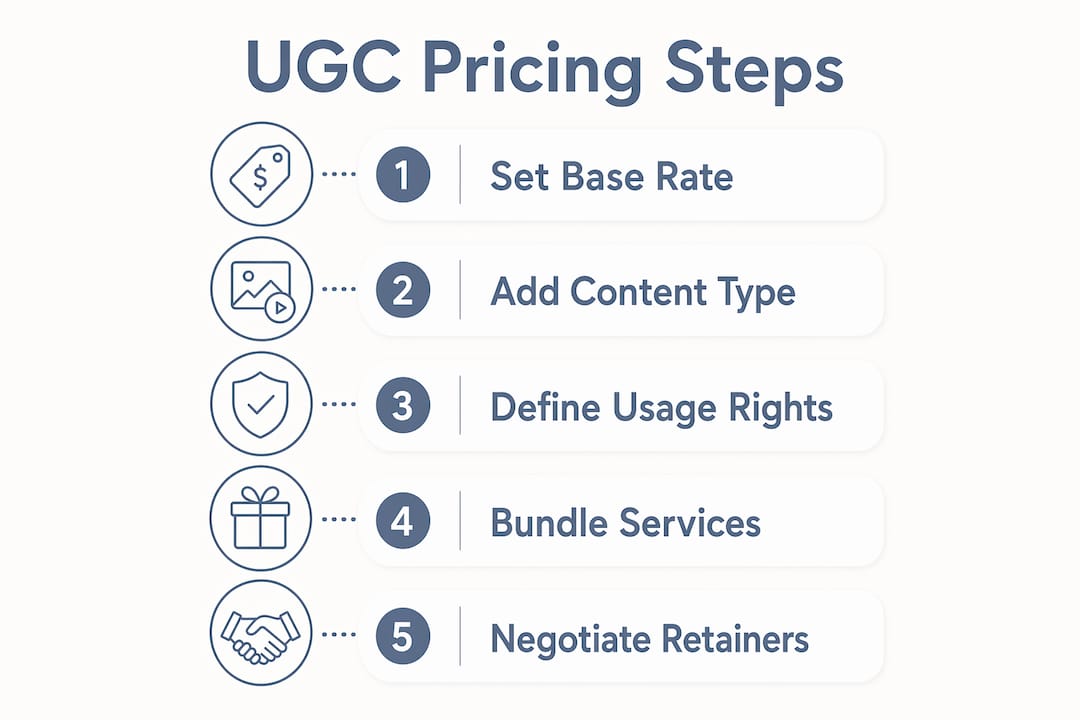
Single-video pricing is the entry point, but bundles and retainers are where creators build real income stability. Brands prefer bundles because they reduce negotiation time and lock in content volume. Creators benefit because bundles reduce per-project admin and create predictable cash flow.
Standard package ranges
A package of 3–5 videos with 90-day usage rights typically costs $1,200–$3,000. Monthly retainers covering 8–12 deliverables range from $2,500–$6,000. These figures reflect the Australian market in 2026 and assume standard paid media usage rights are included.
The table below shows how pricing scales across common package structures:
| Package Type | Deliverables | Typical Rate Range |
|---|---|---|
| Single video (organic) | 1 video | $150–$350 |
| Single video (paid media) | 1 video + 90-day rights | $220–$525 |
| Starter bundle | 3 videos + 90-day rights | $1,200–$1,800 |
| Growth bundle | 5 videos + 90-day rights | $2,000–$3,000 |
| Monthly retainer | 8–12 deliverables | $2,500–$6,000 |
Why retainers benefit both sides
Retainers give brands scheduling certainty and volume discounts. They give creators guaranteed monthly income and the ability to plan production. A retainer also builds a deeper brand relationship, which often leads to rate increases at renewal. Brands that renew retainers typically add whitelisting or extended usage rights, which increases total contract value without requiring new negotiations.
- Agree on deliverable count and format before signing. Specify video length, platform, and revision rounds.
- Include a usage rights clause that defines the license period and paid media permissions explicitly.
- Set a renewal review date at the 90-day mark to renegotiate rates based on performance data.
- Price raw footage separately even within retainers. Raw files are a distinct asset with independent commercial value.
- Add a kill fee clause so you are compensated if a brand cancels mid-retainer.
How marketing teams can use UGC pricing data to optimize spend
Marketing teams in Queensland and across Australia now operate with layered content strategies. Brands use low-cost AI-generated clips priced at $5–$15 per asset, mass-scale human UGC at $20–$25, and premium hero assets at $100–$300. Each tier serves a different campaign function. AI clips fill volume gaps. Human UGC builds trust and conversion. Premium assets anchor brand identity.
The shift toward layered strategies means marketing teams must budget by content function, not just content type. Allocating the entire UGC budget to a single creator tier leaves gaps in the content funnel. A balanced mix produces better campaign performance across awareness, consideration, and conversion stages.
Selecting creators by engagement rate rather than follower count is the most cost-effective approach. Micro-influencers with 10,000–50,000 followers charge $400–$1,200 per UGC project. Nano-influencers with 1,000–10,000 followers charge $150–$250 per video. Both tiers often outperform larger accounts on conversion metrics because their audiences are more engaged and trust their recommendations.
Key practices for marketing teams managing UGC budgets:
- Negotiate usage rights upfront. Define the license period, platforms, and paid media permissions before briefing begins.
- Track whitelisting fees separately. Whitelisting grants brands access to run ads through a creator's account, and it costs $100–$200+ per video. Budget for it as a line item.
- Plan for renewals. Usage rights expire. Build renewal costs into campaign timelines to avoid content gaps.
- Use engagement data to evaluate creators. Request engagement rate reports before signing. A 7% engagement rate on a small account outperforms a 1% rate on a large one.
Pro Tip: Request a performance report from any creator you have worked with before renewing. Renewal rates should reflect what the content actually delivered, not just what was originally agreed.
Practical tips for UGC creators to maximize earnings in Australia
The most common mistake Australian UGC creators make is undercharging. Many micro-influencers undercharge by 30–60% initially because they lack access to honest, localized benchmark data. Pricing from gut feel or copying international rates without adjusting for the Australian market leads to consistent undervaluation.
Separating base creation fees from usage rights is the single most effective structural change a creator can make. Creators who bundle everything into one flat fee leave money on the table. The industry standard is to charge a base creation fee plus a 30–50% premium for 90-day paid media usage. Perpetual rights should cost significantly more.
Raw footage is an overlooked revenue stream. Raw footage buyouts bring at least 50% extra on project fees. Brands use raw files to repurpose content across multiple campaigns without returning to the creator. Price raw footage as a separate line item on every quote.
Additional tips for creators building a sustainable UGC income:
- Itemize every add-on. Hooks, captions, scriptwriting, and whitelisting are separate services. List them separately so brands understand what they are paying for.
- Lead with engagement data, not follower count. A strong engagement rate justifies higher fees regardless of audience size.
- Register your ABN early. UGC income is assessable in Australia. Operating without an ABN creates tax complications and signals unprofessionalism to brands.
- Use written contracts for every project. Verbal agreements do not protect your usage rights or payment terms.
Pro Tip: Add a usage rights expiry clause to every contract. When the license expires, brands must renegotiate. That renewal conversation is your opportunity to increase your rate.
Key Takeaways
Australian UGC rates are defined by experience tier, usage rights, and content type, and creators who price these elements separately earn significantly more than those who bundle everything into a flat fee.
| Point | Details |
|---|---|
| Beginner rate baseline | Beginners charge $150–$350 per video; established creators charge $1,000 or more. |
| Usage rights add 30–50% | Pricing 90-day paid media rights separately increases total payment significantly. |
| Retainers build stability | Monthly retainers covering 8–12 deliverables range from $2,500–$6,000 in Australia. |
| Engagement beats follower count | Creators with 7% engagement can charge 1.5x–2x the rate of low-engagement larger accounts. |
| Raw footage is billable | Raw footage buyouts should be priced at a minimum of 50% of the base project fee. |
The UGC rate conversation Australia still needs to have
The rate data is clearer than it has ever been, but the behavior has not caught up. I work with creators and marketing teams regularly, and the gap between what creators charge and what the market will pay is still wide in Queensland. Most of the time, the creator is on the wrong side of that gap.
The problem is not confidence. It is structure. Creators who charge a single flat fee for everything, including usage rights, raw footage, and revisions, are essentially giving brands a discount they never agreed to. The fix is simple: separate every service and price each one. Brands that push back on itemized pricing are usually the ones who were benefiting most from the old flat-fee model.
On the marketing side, I see teams allocate UGC budgets based on follower count alone. That approach consistently underperforms. The data on engagement rate as a pricing signal is clear, and teams that use it select better creators and get better results. The shift toward layered content strategies, mixing AI assets with human UGC and premium hero content, is the right direction. But it only works if the human UGC tier is properly funded and properly contracted.
The near-term shift I expect is more standardized rate cards across the Australian market. As localized benchmark data becomes more accessible, the 30–60% undercharging gap will close. Creators who build proper pricing structures now will be positioned well when that happens. Brands that establish fair, transparent contracts now will retain the best creators when rates normalize upward.
— Jonathan
How Bridgepr supports UGC campaigns for Australian brands
Bridgepr works with restaurants, cafés, and bars across Queensland to build content strategies that actually move bookings and recommendations. If you are a marketer trying to build a UGC content mix that performs, or a creator looking to price your work correctly and protect your usage rights, Bridgepr's influencer services are built for exactly that.

Bridgepr pairs brands with food creators and local influencers whose engagement data backs up their rates. Every campaign includes clear usage rights agreements, transparent fee structures, and content that feels credible to Queensland audiences. The result is UGC that earns its place in a paid media budget rather than just filling a content calendar.
FAQ
What are standard UGC rates in Australia for 2026?
Beginner creators charge $150–$350 per 15–30 second video. Established creators with performance data charge $1,000 or more per video, with packages of 3–5 videos ranging from $1,200–$3,000.
How do usage rights affect UGC payment rates?
Usage rights for 90-day paid media add 30–50% to the base creation fee. Perpetual or unlimited usage rights cost significantly more and should always be negotiated as a separate line item.
Do Australian UGC creators need to register for GST?
Yes. UGC income is assessable in Australia, and creators must register for GST once their annual turnover exceeds $75,000. An ABN is required regardless of income level.
Is engagement rate or follower count more important for UGC pricing?
Engagement rate is the stronger pricing signal. Micro-creators with 7% engagement can charge 1.5x–2x the rates of larger accounts with low engagement, making engagement data the key metric for both creators and brands.
What add-ons should UGC creators charge for separately?
Standard add-ons include hook variations ($50–$150), whitelisting ($100–$200+), raw footage buyouts (at least 50% of the project fee), rush fees (25–50% surcharge), and closed captions (approximately $25 per video).