
For Australian ecommerce businesses on Shopify, WooCommerce, or BigCommerce, Klaviyo is the stronger platform. Its native real-time integrations, behavioral segmentation, and 60+ pre-built ecommerce flows give it a clear edge over Mailchimp for product-based stores. Mailchimp, on the other hand, wins for small businesses, service providers, and content creators who need an affordable, all-in-one marketing suite without the complexity of a full automation platform.
Here is the short version:
- Klaviyo suits ecommerce brands that rely on Shopify or WooCommerce, need deep behavioral segmentation, and want predictive analytics like customer lifetime value and churn risk scoring.
- Mailchimp suits small businesses, nonprofits, and service brands that want fast campaign setup, a website builder, and social media tools bundled together.
- ActiveCampaign is a Queensland-based alternative with AI-driven automation and personalized email marketing, worth considering for businesses that want local support and custom pricing.
How do Mailchimp, Klaviyo, and ActiveCampaign compare for ecommerce?
The three platforms sit in different lanes. One table makes the split obvious.
| Platform | Best For | Pricing (500 contacts) | Automation | Shopify Integration | Ease of Use | Support | Rating |
|---|---|---|---|---|---|---|---|
| Klaviyo | Ecommerce brands needing deep data and behavioral automation | $45/mo (Email plan) | 60+ pre-built ecommerce flows, omnichannel | Native, real-time sync | Moderate learning curve | Email and chat (paid); 60-day free support | 3.5★ (71 reviews) |
| Mailchimp | Small businesses, content creators, service brands | $13/mo (Essentials) | 100+ prebuilt flows, Customer Journey Builder | Third-party connector required | Very easy | Email and chat (paid); 30-day free support | 2.6★ (25 reviews) |
| ActiveCampaign | Businesses needing AI-driven personalization and automation | Custom (contact-based) | AI-driven workflows, SMS, campaign optimization | Available via integrations | Moderate | Demo-based onboarding | 3.8★ (99 reviews) |
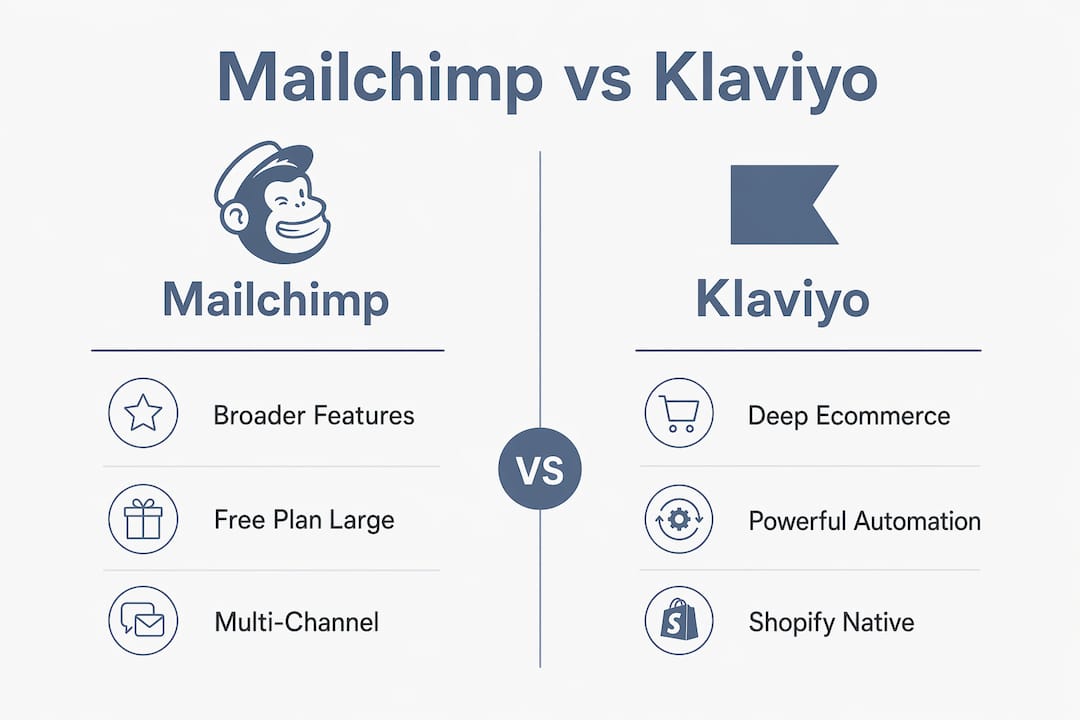
Klaviyo's ecommerce depth. The platform's native Shopify integration syncs purchase history, browse behavior, and cart events in real time. Flows trigger off that data automatically, with no CSV exports or batch delays. Klaviyo also includes predictive analytics covering customer lifetime value, churn risk, and next-purchase predictions at the individual customer level. Mailchimp's predictive analytics are limited to basic send-time optimization.
Mailchimp's breadth. Where Mailchimp genuinely pulls ahead is scope. It manages email, SMS, landing pages, social posts, ads, and surveys from one platform. Its Creative Assistant imports your logo and brand colors automatically. For a hospitality venue or a service business running event packages and newsletters side by side, that all-in-one setup saves real time.

Segmentation gap. Mailchimp restricts segmentation to 5 conditions per group; Klaviyo removes that limit entirely. Klaviyo's segments update dynamically in real time, pulling in behavioral, transactional, and predictive data. Mailchimp's are filter-based and static by comparison.
ActiveCampaign rounds out the field with AI-driven campaign building and SMS automation. Pricing is custom based on contact count and business goals, so it suits teams that want a tailored setup rather than a self-serve tier.
Is Klaviyo or Mailchimp cheaper for Australian stores?
Price depends heavily on list size and which features you actually need.
Mailchimp's free plan covers up to 500 contacts and 1,000 monthly sends, though most automation features are locked behind paid tiers. The Essentials plan starts at $13/month for 500 contacts, with Standard at roughly $20/month adding behavioral targeting and A/B testing. Premium, required for advanced segmentation and multivariate testing, starts at $350/month for 10,000 contacts.
Klaviyo's free plan covers 250 contacts and 500 sends, but unlocks the full feature set including multi-step automations and A/B testing. Paid plans start near $45/month for 500 contacts, scaling to roughly $175/month for 10,000 active profiles. All features are included at every paid tier.
The pricing model difference matters more than the headline numbers. Mailchimp charges per list placement, so a single contact appearing in three audiences counts as three billable contacts. Klaviyo uses a single-profile model: one person, one charge, regardless of how many segments they belong to. For stores with overlapping audiences, that difference adds up fast.
At high contact volumes, Mailchimp's nominal prices are lower on paper, but real costs vary depending on the feature tiers required and list structures. Mailchimp is cheaper at scale on paper, but if accessing its full ecommerce feature set requires the Premium tier, the real cost comparison shifts.
- Klaviyo's SMS is priced separately by message volume, with 150 free SMS messages per month on paid plans.
- Mailchimp sells SMS as a separate add-on, available only on Essentials or higher, with country availability restrictions.
Pro Tip: Before committing to either platform, run both free plans simultaneously for 30 days. Klaviyo's free tier gives you full feature access up to 250 contacts; Mailchimp's gives you more contacts but fewer features. Testing both with real campaigns reveals workflow fit faster than any comparison article.
How to choose between Mailchimp and Klaviyo for your Queensland store
The decision comes down to what your business actually sells and how sophisticated your marketing needs to be right now.
Choose Klaviyo if:
- Your store runs on Shopify, WooCommerce, or BigCommerce and abandoned cart recovery, browse abandonment, and post-purchase sequences drive meaningful revenue.
- You need behavioral segmentation beyond basic filters, including predictive signals like churn risk and next-order date.
- You want email and SMS under one attribution model without stitching together separate tools.
- You are ready to invest setup time upfront for compounding returns over time.
Choose Mailchimp if:
- You run a service business, café, bar, or content brand that needs newsletters and social posts more than ecommerce automation.
- Your team is small and non-technical, and fast onboarding matters more than segmentation depth.
- You want a website builder and landing pages bundled with your email tool.
- Budget is tight and the free tier or Essentials plan covers your current volume.
The core tradeoff is speed versus control. Mailchimp gets campaigns out faster with less setup. Klaviyo gives you more control over targeting, channels, and campaign logic, but it asks for more attention upfront. For a Queensland retailer scaling past a few thousand contacts, Klaviyo's revenue attribution across multiple touchpoints tends to justify the higher cost. For a local café managing a weekly newsletter and occasional promotions, Mailchimp's simplicity is genuinely the better fit.

Migrating from Mailchimp to Klaviyo
Switching platforms is manageable, but it requires a few deliberate steps to avoid losing data or breaking automations.
- Export contacts from Mailchimp as a CSV, including tags and custom fields. Direct tag syncing between the two platforms is not available, so you will need to map tags manually during import into Klaviyo.
- Reconnect your ecommerce store. Klaviyo's setup requires re-connecting store integrations to fully activate automation flows. Install the Klaviyo app from the Shopify App Store and let the native integration pull in historical purchase and browse data.
- Rebuild your segments. Mailchimp's audience structure and Klaviyo's profile model work differently. Take the migration as an opportunity to clean your list and rebuild segments using Klaviyo's behavioral and predictive filters rather than replicating Mailchimp's static lists.
- Test before going live. Run key flows, including abandoned cart and welcome sequences, in test mode before switching off Mailchimp. Check that triggers fire correctly and that revenue attribution is tracking.
The migration itself takes a weekend for most small stores. The bigger investment is rebuilding automations to take advantage of what Klaviyo actually does well, which is where the real payoff comes.
Bridgepr is a different kind of marketing partner for Queensland venues
Email platforms handle the broadcast. What they cannot do is build the kind of credibility that fills tables and drives bookings in Queensland's competitive hospitality market.
Bridgepr works with restaurants, cafés, and bars to create the content, influencer campaigns, and PR-style storytelling that make a venue worth talking about before anyone opens an email. Where Klaviyo or Mailchimp automates what you send, Bridgepr shapes what people say about you offline and on social, giving your email list something worth opening. If you are running a venue and want marketing that works at the street level, not just in the inbox, Bridgepr's hospitality packages are built for exactly that.
Key Takeaways
Klaviyo is the stronger choice for Australian ecommerce brands on Shopify or WooCommerce, while Mailchimp suits small businesses and service brands that prioritize ease of use and lower starting costs.
| Point | Details |
|---|---|
| Ecommerce fit | Klaviyo's 60+ pre-built flows and native Shopify sync outperform Mailchimp for product-based stores. |
| Pricing model | Mailchimp charges per list placement; Klaviyo charges once per contact regardless of segment count. |
| Starting cost | Mailchimp Essentials starts at $13/mo for 500 contacts; Klaviyo's Email plan starts at $45/mo. |
| Segmentation depth | Klaviyo removes condition limits entirely; Mailchimp caps segments at 5 conditions per group. |
| Bridgepr | For Queensland venues wanting credibility beyond the inbox, Bridgepr pairs content strategy with influencer campaigns that drive bookings. |