
Brand deals are defined as paid or gifted partnerships where a creator produces content that promotes a brand's product or service to their audience. Knowing how to get brand deals is no longer a passive process. The market has shifted decisively toward smaller creators: 89% of marketers now prioritize micro and nano-influencers over larger accounts. That shift means creators with 5,000 to 50,000 engaged followers in Queensland and across Australia are sitting on real commercial opportunity. The creators who capture it are the ones who treat outreach like a business, not a wish.
How to get brand deals: building a brand-ready profile
The first thing brands check is your profile. Before any pitch lands in an inbox, your social presence either passes or fails a 30-second credibility test.
Nail your niche first
A narrow content focus is more attractive to brands than generalist content, especially for smaller creators. A Brisbane food creator who posts exclusively about inner-city brunch spots is far easier to pitch to a café group than a creator who covers food, travel, fitness, and lifestyle. Specificity signals expertise. Brands pay for access to the right audience, not just any audience.
Optimize your profiles for credibility
Your bio, profile photo, link in bio, and content grid all communicate professionalism before you say a word. Use a consistent visual style across posts. Write a bio that names your niche, your location, and who you serve. A creator based in Brisbane who writes "Queensland food and lifestyle creator" immediately signals local relevance to hospitality brands looking for regional reach.

Build a professional media kit
Creators with professional media kits close deals 3x faster than those without one. A media kit is a one to two-page document that includes your audience demographics, platform stats, engagement rate, content examples, past collaborations, and rate card. It removes friction from the brand's decision process by answering every qualifying question upfront.
- Audience demographics: age, gender, location breakdown
- Engagement rate: total interactions divided by reach, expressed as a percentage
- Content samples: two to three high-performing posts with captions
- Past brand work: screenshots or links to previous sponsored content
- Rate card: your pricing per deliverable type
Engagement rate is more critical than follower count for brand deal pricing and earning potential. A creator with 8,000 followers and a 9% engagement rate is more valuable to most brands than one with 80,000 followers and a 0.8% rate.
Pro Tip: Include one short case study in your media kit. Show a brand you worked with, the content you created, and the result. Even a single example of "this post drove 200 link clicks" builds credibility that raw stats cannot.
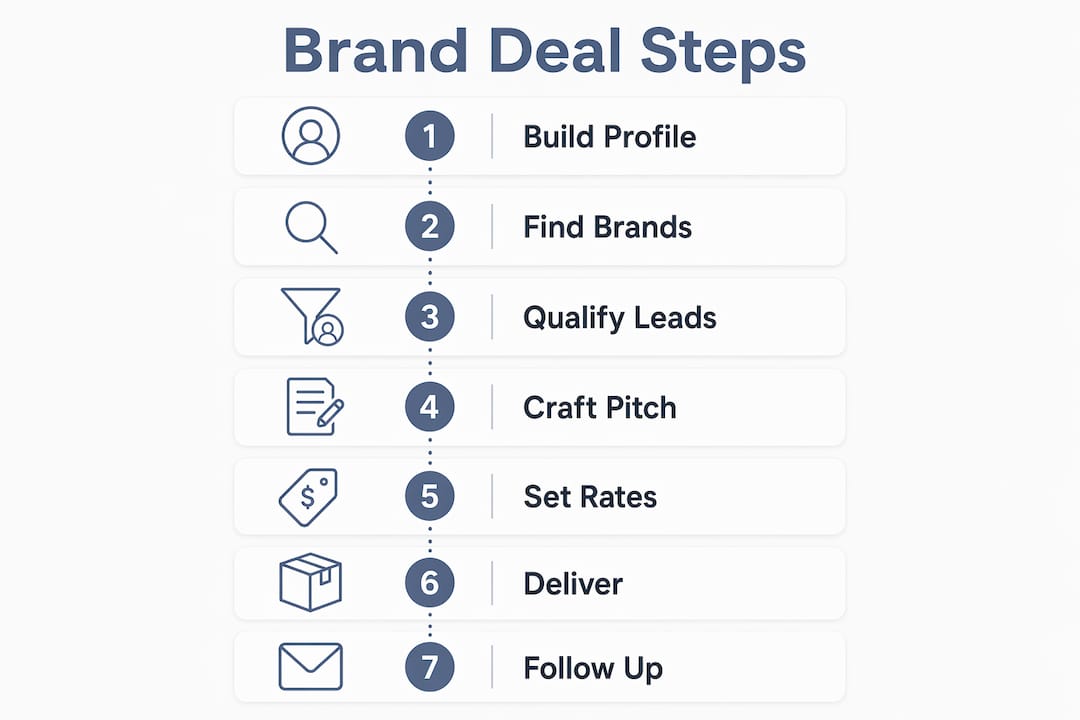
How do you find the right brands to approach?
Targeting the wrong brands wastes time and damages your positioning. The goal is to build a shortlist of brands that already spend on creator marketing, fit your niche, and work with creators at your audience size.
Research methods that work
Start by auditing your own content. List every product or venue you already feature organically. Brands that appear in your content without payment are your warmest leads because you have genuine affinity with them. From there, search Instagram and TikTok for sponsored posts in your niche using the "Paid partnership" label. Note which brands are actively running creator campaigns.
- Search your niche hashtags for "paid partnership" tags to identify active brand spenders.
- Check brand websites for a "work with us" or "creator program" page.
- Review creator marketplaces that connect brands with influencers for open campaign briefs.
- Follow brand marketing accounts on LinkedIn to track campaign launches and hiring signals.
- Ask your network of fellow creators which brands have reached out to them recently.
Qualify before you pitch
Not every brand that fits your niche is worth pitching. Filter your list by three criteria: product fit with your audience, the brand's history of working with creators at your size, and visible marketing activity in the last 90 days. A brand that last ran a creator campaign two years ago is a cold lead. A brand that posted three sponsored collaborations last month is ready to buy.
| Qualification criterion | Green light signal | Red flag |
|---|---|---|
| Product fit | You use or would use it | Unrelated to your content |
| Creator size preference | Works with micro creators | Only features celebrities |
| Marketing activity | Active campaigns in 90 days | No recent creator content |
| Budget indicators | Paid posts, not just gifting | Gifting only, no fee history |
Pro Tip: Search "[brand name] + influencer" on Google to find past creator campaigns. If results show paid partnerships with creators at your size, the brand has both the appetite and the budget.
What makes a pitch actually get a response?
Personalized brand pitches referencing a recent campaign achieve 3–5x higher response rates than generic outreach. That single fact should shape every email you send.
The anatomy of a pitch that works
A strong pitch is under 150 words and answers four questions in sequence: who you are, why you chose this brand specifically, what you would create, and what you want the brand to do next.
- Subject line: specific and personal, e.g., "Partnership idea for [Brand] x [Your Handle]"
- Opening line: reference something real, e.g., "I loved your recent campaign with [creator name] and think my audience of Brisbane food lovers would respond similarly."
- Audience fit: one sentence on who follows you and why they match the brand's customer.
- Content idea: one specific deliverable, e.g., "A Reel featuring your new menu at [venue], posted during the Friday lunch window."
- Call to action: one clear ask, e.g., "Would you be open to a quick call this week?"
Keep the tone professional but direct. Brands receive dozens of pitches weekly. Yours needs to show you did the work, not just that you want the money.
Pro Tip: Follow up 3–5 days after your initial email if you receive no reply. Follow-up emails recover 40–60% of lost opportunities. One polite follow-up is not annoying. It shows you are serious.
How do you set and negotiate your rates?
Pricing is where most creators leave money on the table. The fix is a formula, not a feeling.
Use CPM-based pricing
CPM-based formulas ensure creators price based on actual performance, improving deal fairness and recurring income. A basic starting point: multiply your average views or impressions by your CPM rate (typically $10–$30 per 1,000 views depending on platform and niche). Add a production fee on top. This gives you a defensible number, not a guess.
Package your deliverables
Bundling deliverables such as a Reel, Stories, and usage rights increases average deal value by 40–60%. Brands prefer packages because they simplify their planning. You benefit because bundling raises your total fee without requiring a separate negotiation for each asset.
Treat usage rights as a separate line item. Creators should price usage rights as a licensing product, charging separately for duration, geography, and format, often at 25–100% above base content rates. A brand that wants to run your content as a paid ad for six months should pay significantly more than one that only wants an organic post.
Exclusivity requires clearly defined categories and limited time windows to avoid blocking future income. If a café brand asks for exclusivity in the "food and beverage" category, push back and narrow it to "café dining in Brisbane" with a 60-day window. Broad exclusivity clauses can cost you multiple deals.
68% of brands expect to negotiate down from the initial ask. Quote 20–30% above your target rate to maintain margin. That buffer is not dishonesty. It is standard commercial practice on both sides of the table.
Pro Tip: Request a 50% upfront deposit before you begin any content creation. Payment on delivery terms protect creators from non-payment risks. Net-30 payment terms are common but can create cash flow gaps, especially for newer creators.
How do you turn one deal into a long-term partnership?
One-off deals pay the bills. Long-term brand ambassadorships build a career. Long-term partnerships pay 3–5x more per deliverable than one-off sponsorships. The path from single deal to recurring contract runs through your delivery and your follow-up.
Over-deliver on the first campaign
Send your content before the agreed deadline. Include a bonus asset, such as an extra Story frame or a behind-the-scenes clip, without charging for it. Brands remember creators who make their lives easier. That goodwill converts directly into repeat bookings.
Send a performance recap within 48 hours
Creators who send performance recaps within 48 hours of a campaign going live convert 60–70% of one-off deals into recurring partnerships. A recap does not need to be elaborate. A one-page document with your post reach, engagement rate, link clicks, and two to three audience comments is enough.
- Reach and impressions: total accounts reached during the campaign window
- Engagement rate: likes, comments, saves, and shares as a percentage of reach
- Link clicks or swipe-ups: direct traffic driven to the brand
- Audience sentiment: two to three positive comments that show genuine audience interest
- Your recommendation: one sentence on what you would do differently or double down on next time
That last point is the most important. Brands do not just want data. They want a creator who thinks like a partner. Ending your recap with "I'd recommend running a second post during the dinner window based on when engagement peaked" positions you as someone worth keeping on retainer.
Key Takeaways
Creators who treat brand partnerships as a business, not a side hustle, consistently outperform those who wait for brands to come to them.
| Point | Details |
|---|---|
| Niche focus wins deals | A specific content niche makes you easier to pitch and more attractive to relevant brands. |
| Media kits close deals faster | A professional media kit with engagement data and case studies cuts the brand's decision time significantly. |
| Personalize every pitch | Reference a real campaign or product detail to achieve response rates 3–5x higher than generic outreach. |
| Quote above your target rate | Start 20–30% above your floor, since most brands expect to negotiate down from the first number. |
| Recap fast to earn repeat work | Sending a performance recap within 48 hours converts the majority of one-off deals into ongoing partnerships. |
What I've learned watching creators get this wrong
The biggest mistake I see creators make is treating brand deals as a lottery. They post great content, wait for a DM, and wonder why nothing comes. The market does not work that way, especially not in Queensland where the hospitality and lifestyle sector is competitive and brands have real options.
What actually works is treating your creator business like a sales operation. That means a media kit that is ready before you need it, a shortlist of target brands you update monthly, and a pitch template you personalize for every single send. Professionalism at this level is rare among creators, which is exactly why it gets noticed.
The other thing I have observed is that creators undervalue their negotiating position. A brand that has already said yes to a meeting has already decided you are worth talking to. That is leverage. Use it to protect your rates, your usage rights, and your exclusivity terms. The creators who build sustainable income are not the ones with the most followers. They are the ones who understand that every deal is a business transaction, and they show up prepared for it.
Authenticity still matters, but it is not a substitute for professionalism. The best creators I have seen work with Queensland hospitality brands are the ones who love the product and also know their numbers cold.
— Jonathan
How Bridgepr connects creators with the right brand partners
Bridgepr works with food creators, lifestyle influencers, and social media talent across Queensland to place them inside campaigns that actually convert. The team pairs creators with restaurants, cafés, and bars that need credible, local content, and manages the partnership from brief to recap so creators can focus on what they do best.
If you are a creator ready to move from occasional gifting to paid brand partnerships, Bridgepr offers the industry connections and campaign management to get you there. Visit Bridgepr to learn how the team matches Queensland creators with hospitality brands looking for exactly what you produce.
FAQ
How many followers do I need to get brand deals?
Follower count matters less than engagement rate. Brands now prioritize micro and nano-influencers, and creators with as few as 1,000 highly engaged followers can secure paid partnerships.
What should I include in a media kit?
A media kit should include your audience demographics, engagement rate, platform stats, content samples, past brand work, and a rate card. Creators with professional media kits close deals 3x faster than those without one.
How do I price my first brand deal?
Use a CPM-based formula: multiply your average impressions by your CPM rate and add a production fee. Quote 20–30% above your target to leave room for negotiation, since most brands expect to negotiate down.
How do I approach brands in Brisbane or Queensland?
Research brands that are already running creator campaigns in your niche and location. Pitch with a personalized email under 150 words that references a specific campaign or product, and follow up within 3–5 days if you receive no reply.
How do I turn a one-off deal into a recurring partnership?
Send a performance recap within 48 hours of your post going live. Include reach, engagement, and a recommendation for the next campaign. Creators who do this convert the majority of single deals into ongoing brand relationships.